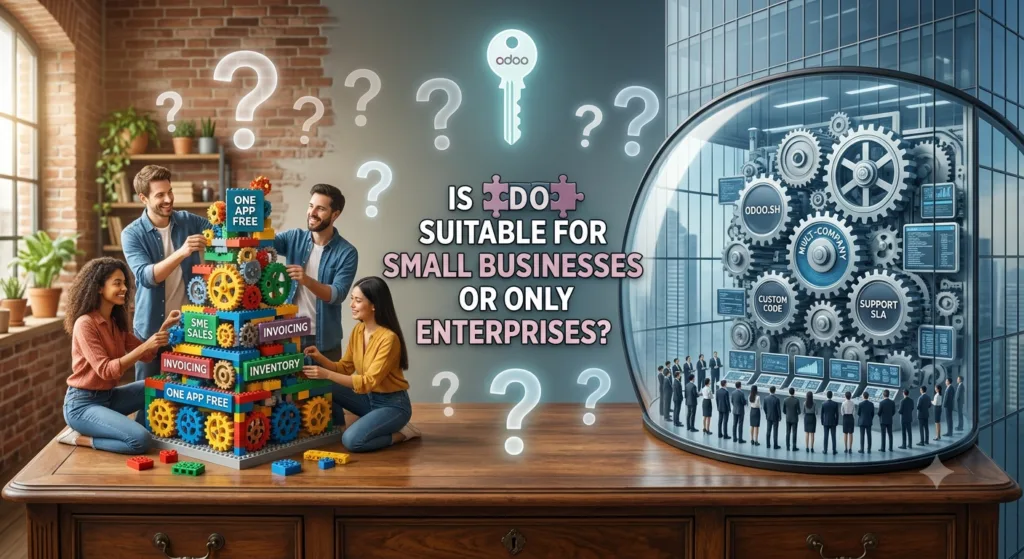
When small business owners first discover Odoo, one question often comes up:
“Is Odoo really suitable for a small business, or is it mainly designed for large enterprises?”
The answer is simple: Odoo can be suitable for businesses of many different sizes, from small companies and startups to large international organizations.
Odoo offers an integrated suite of business applications covering CRM, sales, accounting, inventory, purchasing, manufacturing, project management, ecommerce, HR, point of sale, and more. This allows a small business to start with the applications it actually needs and expand its Odoo system as the company grows.
At the same time, Odoo is capable of supporting complex organizations with multiple companies, countries, currencies, warehouses, users, and integrations.
This flexibility is one of the reasons businesses of very different sizes use Odoo.
Is Odoo Good for Small Businesses?
Yes. In fact, Odoo can be particularly useful for small and medium-sized businesses that have outgrown spreadsheets or disconnected software applications.
A small company may start with just a few applications:
CRM + Sales + Accounting
As the company grows, it can add:
Purchase + Inventory + Project Management + HR + Ecommerce
This means a business does not necessarily need to implement every Odoo application from day one.
For a small business, this can be an important advantage because you can build your ERP system gradually rather than implementing a massive system all at once.
Why Small Businesses Choose Odoo
Small businesses often face a common problem: information is spread across too many systems.
For example, a company might use:
- Excel for inventory
- Gmail for customer communication
- QuickBooks for accounting
- Separate software for quotations
- Another application for projects
- Spreadsheets for reporting
As the company grows, this creates duplicated data and manual work.
Odoo can bring many of these processes together.
For example:
Lead → Quotation → Sales Order → Delivery → Invoice → Payment
Instead of entering the same customer and order information into several systems, the information can flow through an integrated ERP system.
Odoo for a 5-Person Business
A company with only a few employees may not need a complex ERP implementation.
For example, a five-person professional services company might need:
- CRM
- Sales
- Project management
- Timesheets
- Invoicing
- Accounting
Odoo can bring these processes into one system.
The business can track a customer from the initial opportunity through quotation, project delivery, timesheets, invoicing, and payment.
This can provide much better visibility than managing the process through spreadsheets and separate applications.
Odoo for a 20–50 Employee Business
As a company grows, operational complexity increases.
A 20–50 employee company might need:
- CRM
- Sales
- Purchase
- Inventory
- Accounting
- Projects
- HR
- Attendance
- Payroll
- Manufacturing
- Ecommerce
The exact requirements depend on the industry.
For example, a distribution company may prioritize inventory and purchasing, while a consulting company may prioritize CRM, projects, timesheets, and accounting.
Odoo allows businesses to select the applications that match their processes.
Odoo for 100+ Employees
Odoo is not limited to small companies.
Larger organizations can use Odoo for more complex operations involving:
- Multiple departments
- Multiple warehouses
- Multiple companies
- Multiple currencies
- Multiple countries
- Large product catalogs
- Complex approval processes
- Manufacturing
- Ecommerce
- Advanced reporting
- External integrations
At this stage, the implementation approach becomes particularly important.
A larger Odoo implementation may require dedicated project management, business analysis, custom development, data migration, integrations, testing, and ongoing support.
Do Large Companies Actually Use Odoo?
Yes.
Odoo’s official customer references include organizations across many industries and countries. Its published references include both smaller businesses and well-known international organizations.
Some recognizable examples include Toyota Material Handling, Danone, Sodexo, WWF, and Hyundai, which Odoo identifies among organizations using its platform.
Toyota Material Handling
Toyota Material Handling has used Odoo in parts of its European operations, including distribution and supply-chain management. Odoo’s published case material describes its use across operations in Sweden, Italy, and France.
This is a useful example because it demonstrates that Odoo is not restricted to small businesses.
Grameen Danone
Grameen Danone Foods Limited, a joint venture involving the Grameen Group and Groupe Danone, uses Odoo ERP to integrate its operations. Odoo’s customer reference describes its manufacturing and operational ecosystem in Bangladesh.
Sodexo, WWF and Hyundai
Odoo also identifies Sodexo, WWF, and Hyundai among organizations using Odoo. These examples demonstrate the platform’s ability to support organizations operating at significant scale.
The important point is not that a small company should copy the ERP setup of a multinational.
The point is that the same platform can scale with very different business requirements.
Odoo for Startups
Odoo can also be considered by startups that want to avoid building their operations around disconnected applications.
A startup may initially need only:
- CRM
- Sales
- Invoicing
- Accounting
As the business grows, it may add:
- Inventory
- Purchase
- Ecommerce
- Marketing
- HR
- Projects
This creates a potential path from a relatively simple initial setup toward a more comprehensive ERP.
However, startups should avoid implementing unnecessary functionality simply because it is available.
The ERP should match the company’s current operational needs.
Odoo for Family-Owned Businesses
Odoo can also be useful for family-owned and privately owned businesses that have traditionally relied on spreadsheets or older software.
For example, a family-owned distributor might have:
Sales → Purchase → Inventory → Accounting
The business may currently manage these activities through several disconnected tools.
An Odoo implementation can bring these processes together and provide management with a centralized view of operations.
This can be particularly useful when a business is transitioning from an owner-managed operation to a more structured organization.
Odoo for Small Manufacturing Companies
Small manufacturers often need more than basic accounting and sales software.
They may need:
- Bills of materials
- Manufacturing orders
- Work centers
- Inventory
- Purchasing
- Quality
- Maintenance
- Sales
- Accounting
Odoo can connect these processes.
For example:
Sales Order → Manufacturing Order → Raw Material Consumption → Finished Product → Delivery → Invoice
This gives management greater visibility into production and inventory.
Odoo for Small Ecommerce Businesses
An ecommerce business may also benefit from an integrated ERP.
A typical process could be:
Website → Customer Order → Inventory → Delivery → Invoice → Accounting
Instead of manually transferring orders between an ecommerce platform, warehouse system, and accounting software, integrations can synchronize information with Odoo.
As the business grows, additional functionality can be introduced.
Odoo for Service Companies
Service businesses often have different requirements from product-based companies.
A consulting, software, engineering, or marketing company may need:
- CRM
- Sales
- Projects
- Timesheets
- Expenses
- Invoicing
- Accounting
A typical workflow could be:
Lead → Opportunity → Quotation → Project → Timesheet → Invoice
This provides a complete view of the customer relationship and project profitability.
Is Odoo Too Complicated for a Small Business?
It can be if it is implemented incorrectly.
Odoo offers a large number of applications and features.
A small company does not need to use all of them.
One of the biggest mistakes in an Odoo implementation is trying to implement too much functionality too early.
For example, a 10-person company might only need:
CRM + Sales + Accounting
There may be little value in implementing manufacturing, advanced inventory, complex HR workflows, or dozens of third-party applications if the company does not need them.
A good implementation should start with business requirements rather than the number of features Odoo offers.
How Much Does Odoo Cost for a Small Business?
There is no single Odoo implementation price for every small business.
The total cost can depend on:
- Number of users
- Applications required
- Odoo edition
- Implementation effort
- Data migration
- Customization
- Integrations
- Training
- Hosting
- Ongoing support
A small business can often keep costs under control by starting with standard Odoo functionality and implementing only the applications it actually needs.
For example:
Phase 1
CRM + Sales + Accounting
Phase 2
Purchase + Inventory
Phase 3
Projects + HR
Phase 4
Ecommerce + Automation + Integrations
This phased approach can allow the business to spread implementation effort over time.
Should a Small Business Choose Odoo Online, Odoo.sh or Self-Hosted?
The appropriate hosting option depends on the company’s requirements.
Odoo Online
Can be suitable for businesses that primarily need standard Odoo functionality and want a simpler managed environment.
Odoo.sh
Can be useful for companies that require custom development while still wanting a managed Odoo platform.
Self-Hosted Odoo
Can provide greater technical control but requires additional responsibility for infrastructure, security, backups, monitoring, and maintenance.
A small business should choose based on its actual technical and operational requirements rather than simply selecting the cheapest option.
Not sure which hosting option or plan fits your budget? See our Odoo subscription and licensing guide, or contact Mediod Consulting for a free, no-pressure recommendation based on your actual team size.
When Should a Small Business Implement Odoo?
There is no specific employee count at which a company “needs” Odoo.
A business may benefit from Odoo when:
- Spreadsheets are becoming difficult to manage
- Customer data is spread across multiple systems
- Inventory information is unreliable
- Employees manually enter the same information repeatedly
- Management lacks real-time reporting
- Accounting and operations are disconnected
- Sales and purchasing processes are difficult to track
- The business is expanding
- Multiple systems are becoming expensive to maintain
The important question is not:
“Are we big enough for Odoo?”
It is:
“Has our business become complex enough that an integrated ERP would create value?”
When Is Odoo Better for an Enterprise?
Large organizations can benefit from Odoo when they require an integrated platform across multiple departments.
Enterprise requirements may include:
- Multi-company operations
- International accounting
- Multiple currencies
- Multiple warehouses
- Manufacturing
- Complex supply chains
- Advanced user permissions
- Large-scale ecommerce
- Custom integrations
- Advanced reporting
- High-volume transactions
However, large companies should pay particular attention to implementation architecture, scalability, data migration, integrations, and ongoing maintenance.
Small Business vs Enterprise Odoo Implementation
The software platform may be the same, but the implementation approach can be very different.
| Area | Small Business | Enterprise |
|---|---|---|
| Users | Few users | Hundreds or more |
| Applications | Limited | Multiple applications |
| Data Migration | Usually simpler | Often complex |
| Customization | Limited | May be substantial |
| Integrations | Few | Multiple systems |
| Companies | Usually one | Multiple entities |
| Warehouses | Few | Multiple |
| Reporting | Standard/custom | Advanced |
| Training | Small team | Multiple departments |
| Project Management | Simple | Dedicated team |
| Support | As needed | Ongoing/structured |
This is why an Odoo implementation should be designed around the company’s requirements rather than its employee count alone.
Does Odoo Scale as a Business Grows?
One of Odoo’s strengths is that businesses can expand their use of the platform over time.
A small company could begin with:
CRM + Sales + Accounting
Later, it might introduce:
Purchase + Inventory
Then:
Manufacturing + Quality + Maintenance
And eventually:
Ecommerce + Advanced Automation + Integrations
The objective is to create an ERP roadmap that grows alongside the business.
When Odoo Can Be More Than a Small Business Needs
If your business runs on a single core process — say, service invoicing with no inventory — a lighter, purpose-built tool might genuinely serve you better and cost less to maintain. Odoo’s strength is connecting multiple operational areas; if you only have one area to manage, that strength doesn’t buy you much.
Implementation cost is the other honest consideration. Community edition is free to license, but configuration, data migration, and training still take real time — either yours or a partner’s. We break this down fully in our Odoo Pricing guide.
What to Check Before Choosing Odoo
We usually recommend small businesses ask three questions before committing to Odoo: how many separate systems are we trying to replace, how much is manual re-entry actually costing in staff time, and do we expect meaningfully different operational needs in 18–24 months? If the answer to any of those points toward growth or consolidation, Odoo is worth a real evaluation. If the business runs one simple process, it may not be.
Why the Implementation Partner Matters for Small Businesses
A small company may have limited internal IT resources.
This makes choosing the right Odoo implementation partner particularly important.
An experienced partner can help determine:
- Which applications you actually need
- Which processes should be changed
- What should be customized
- What data should be migrated
- Which integrations are necessary
- How to control implementation costs
- How to train employees
- How to plan future phases
The objective should not be to make the Odoo system as complicated as possible.
It should be to make it simple enough for employees to use and powerful enough to support the business.
How Mediod Consulting Helps Small and Growing Businesses
At Mediod Consulting Pvt Ltd, we work with businesses that want to implement Odoo without unnecessary complexity.
Our approach is based on understanding the business first and then designing an Odoo solution around its actual requirements.
We can help with:
- Odoo ERP implementation
- Business process analysis
- Odoo configuration
- Data migration
- Custom Odoo development
- Odoo Studio
- CRM and Sales
- Accounting
- Purchase and Inventory
- Manufacturing
- Project management
- HR and Payroll
- Ecommerce
- API integrations
- Custom reporting
- Odoo upgrades
- Ongoing support
For a small business, we can help identify what should be implemented now and what can be introduced later.
This can help avoid paying for unnecessary functionality while keeping the system ready for future growth.
Get Started with Mediod Consulting
Whether you’re a 5-person startup or a 100-employee company outgrowing spreadsheets, the fastest way to know if Odoo fits is to see it running on your own data. Mediod Consulting is a certified Odoo Partner — book a free consultation and we’ll walk through your specific processes with you, no obligation.
Prefer to explore on your own first? Start a free Odoo trial — sign up through that link and email info@mediodconsulting.com for a 22% discount on your subscription, before or after you buy. Already picked Odoo? Our implementation team can get you live faster than doing it alone.
Frequently Asked Questions
Is Odoo suitable for a small business?
Yes. Odoo can be suitable for small businesses, startups, and growing companies. Businesses can start with a limited number of applications and expand their implementation as their requirements grow.
Is Odoo only for large companies?
No. Odoo is used by organizations of different sizes and across many industries. Odoo’s published customer references include both smaller businesses and major international organizations.
How many employees do you need to use Odoo?
There is no minimum employee count that automatically determines whether Odoo is appropriate. The decision should be based on operational complexity, integration requirements, reporting needs, and expected growth.
Is Odoo affordable for small businesses?
It can be. The overall cost depends on users, applications, implementation, migration, customization, hosting, and support. Starting with the functionality you actually need can help control costs.
Can a small business start with only a few Odoo applications?
Yes. A business can start with applications such as CRM, Sales, or Accounting and add additional applications later as its needs change.
Do large companies use Odoo?
Yes. Odoo’s published references include organizations such as Toyota Material Handling and Grameen Danone, while Odoo also identifies Sodexo, WWF, and Hyundai among organizations using the platform.
Is Odoo suitable for a growing business?
Yes. One of Odoo’s potential advantages is that businesses can expand their use of the platform as their processes become more complex.
Is Odoo Community edition really free for small businesses?
Yes — Community edition has no licensing cost. You pay for hosting, implementation, and any Enterprise-only modules you need. See our pricing guide for a full breakdown.
How long does a small business Odoo implementation take?
For a focused, 2–3 module rollout, we typically see 4–8 weeks from kickoff to go-live. Complexity — not company size — is the main driver of timeline.
Final Thoughts
So, is Odoo suitable for small businesses or only enterprises?
Odoo is suitable for both. A small business does not need to implement Odoo the way a multinational corporation would. The best approach is to start with the business processes that need improvement today and create a roadmap for future requirements.
For a small company, that might mean:
CRM → Sales → Accounting
For a growing company:
CRM → Sales → Purchase → Inventory → Accounting → Projects
For a larger organization:
Multi-company → Manufacturing → Inventory → Ecommerce → Accounting → HR → Integrations → Advanced Reporting
The platform can support all of these scenarios, but the implementation strategy should be different.
The fact that Odoo’s customer references span industries and organizations of different scales—including companies such as Toyota Material Handling and Grameen Danone—demonstrates that Odoo is not limited to one particular business size.
If you are a small or growing business considering Odoo, Mediod Consulting Pvt Ltd can help you determine which Odoo applications you actually need, what should be implemented first, and how to create a scalable ERP roadmap without unnecessary complexity.
Wondering whether Odoo is right for your small business? Contact Mediod Consulting Pvt Ltd for an Odoo implementation assessment.