
Choosing the right Odoo implementation partner can have a major impact on the success, cost, and long-term performance of your ERP project.
Odoo provides a powerful platform with applications for accounting, sales, CRM, inventory, manufacturing, purchasing, HR, ecommerce, projects, and more. However, configuring Odoo correctly for your business requires more than simply installing the software.
The right Odoo partner should understand your business processes, recommend practical solutions, manage data migration, configure Odoo correctly, minimize unnecessary customization, and support your team after go-live.
In this guide, we explain how to choose the right Odoo implementation partner, what questions you should ask, what red flags to avoid, and how to compare Odoo consultants before making a decision.
What Does an Odoo Implementation Partner Do?
An Odoo implementation partner helps your business plan, configure, customize, migrate, test, and launch Odoo.
Depending on your project, an Odoo implementation partner may handle:
- Business process analysis
- Odoo module selection
- Odoo configuration
- Accounting setup
- CRM implementation
- Sales and purchase workflows
- Inventory configuration
- Manufacturing setup
- Data migration
- Custom development
- Third-party integrations
- Reports and dashboards
- User access and permissions
- Testing
- Employee training
- Go-live support
- Ongoing Odoo maintenance
A good implementation partner should not simply do what you ask. They should also challenge inefficient processes and recommend better ways of using Odoo.
Why Choosing the Right Odoo Partner Matters
Odoo is flexible, which is one of its biggest advantages.
But flexibility can also create problems when the implementation is poorly designed.
For example, an inexperienced implementation team may:
- Customize functionality that already exists in Odoo
- Install too many third-party applications
- Migrate unnecessary historical data
- Configure accounting incorrectly
- Build complicated workflows
- Ignore future Odoo upgrades
- Fail to properly test integrations
- Provide insufficient user training
These decisions can create additional costs long after the initial implementation.
The right partner should focus not only on getting Odoo live but also on making the system stable, maintainable, scalable, and easy for your employees to use.
1. Check Their Odoo Experience
The first thing to evaluate is the partner’s practical experience with Odoo.
Do not look only at how long they have been working with ERP systems. Ask specifically about their experience with Odoo and your required modules.
For example, if you need:
- Accounting
- Inventory
- Manufacturing
- CRM
- Ecommerce
- HR
- Payroll
the implementation team should have practical experience in those areas.
Ask potential partners:
“Have you implemented Odoo for a business similar to ours?”
Also ask:
“Which Odoo versions have you implemented?”
Experience with different Odoo versions can be particularly valuable when your project involves migration or upgrading an existing Odoo database.
2. Look for Relevant Industry Experience
Every business uses ERP differently.
A manufacturing company has very different requirements from a professional services company.
A construction company may require:
- Projects
- Timesheets
- Purchase
- Inventory
- Accounting
- Subcontracting
An ecommerce business may prioritize:
- Website
- Ecommerce
- Sales
- Inventory
- Payment gateways
- Shipping integrations
A service company may focus on:
- CRM
- Sales
- Project
- Timesheets
- Invoicing
- Accounting
Therefore, ask the Odoo implementation partner about experience in your industry.
The partner does not necessarily need to have implemented Odoo for exactly the same business, but they should understand your operational requirements.
3. Ask About Their Odoo Certification
Certification can be a useful indicator when comparing Odoo consultants.
However, certification should not be the only factor in your decision.
A certified Odoo consultant with practical implementation experience can bring valuable knowledge of the platform and its standard functionality.
When evaluating a partner, consider a combination of:
- Odoo certification
- Implementation experience
- Technical expertise
- Industry experience
- Client references
- Communication
- Support capabilities
The goal is to find a partner who can combine Odoo knowledge with real-world business experience.
4. Ask for Real Odoo Case Studies
A reliable implementation partner should be able to explain previous projects.
Ask for examples of:
- Similar implementations
- Data migrations
- Custom development
- Odoo integrations
- Accounting implementations
- Ecommerce projects
- Manufacturing projects
- Odoo upgrades
More importantly, ask what problems they solved.
A useful case study should explain:
Problem → Solution → Odoo Configuration → Customization → Result
For example:
The company was managing inventory through spreadsheets and had limited visibility into stock levels. Odoo Inventory was implemented with warehouse locations, automated replenishment, barcode operations, and reporting.
This tells you much more than simply saying:
“We have implemented Odoo for many companies.”
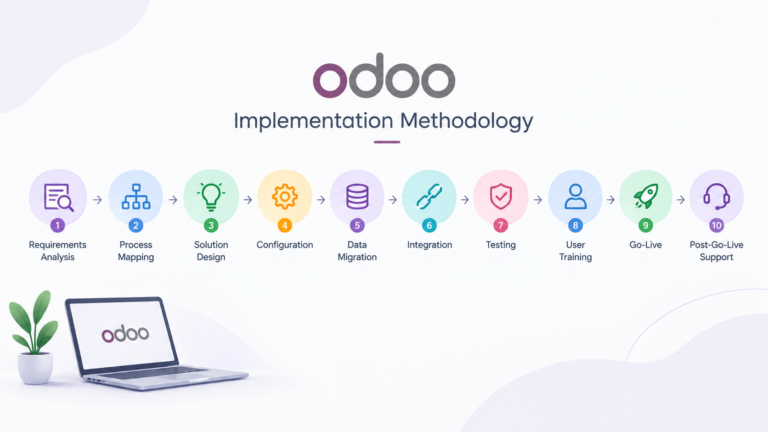
5. Understand Their Implementation Methodology
Ask the partner how they normally implement Odoo.
A structured implementation typically includes:
Discovery
Understand your business processes and requirements.
Solution Design
Determine how Odoo can support those processes.
Configuration
Configure standard Odoo functionality.
Development
Build only the required customizations and integrations.
Data Migration
Clean, transform, and import required data.
Testing
Test workflows and business scenarios.
Training
Train users and administrators.
Go-Live
Move the business to the production Odoo system.
Support
Provide assistance after launch.
If a company wants to immediately start configuring Odoo without first understanding your business, that can be a warning sign.
Not sure what to look for yet? Book a free consultation with Mediod Consulting and we’ll walk you through exactly what to ask any Odoo partner before you sign a contract.
6. Ask Whether They Recommend Standard Odoo or Customization
This is one of the most important questions you can ask.
“Will you customize Odoo or use standard functionality?”
The right answer is not always “we don’t customize.”
Odoo customization can be appropriate when there is a genuine business requirement.
However, customization should not be the first solution.
A good consultant should first ask:
Can Odoo already do this?
If the answer is yes, standard functionality is often preferable.
If not, the consultant can evaluate:
- Configuration
- Odoo Studio
- A suitable existing application
- Custom development
This approach can reduce implementation costs and make future upgrades easier.
7. Evaluate Their Data Migration Experience
If you already have an ERP, CRM, accounting system, or spreadsheets, data migration may be a major part of your project.
Ask:
- How will you migrate our data?
- What data should we migrate?
- How will duplicate records be handled?
- Can historical transactions be migrated?
- How will accounting balances be validated?
- How will inventory be reconciled?
- Will attachments be migrated?
- How many test migrations will be performed?
A professional migration process should generally involve:
Extract → Clean → Transform → Map → Import → Validate → Reconcile
Data migration should not be treated as simply uploading an Excel file.
8. Check Their Technical Capabilities
Your Odoo partner may need to handle more than configuration.
For complex implementations, technical skills can be important.
Look for experience with:
- Python
- Odoo development
- XML
- PostgreSQL
- Odoo APIs
- Third-party APIs
- Git
- Odoo.sh
- Server administration
- Automated integrations
This becomes particularly important if your business requires custom modules or integrations with external systems.
9. Ask About Integrations
Modern businesses rarely operate with only one software system.
You may need Odoo to connect with:
- Ecommerce platforms
- Payment providers
- Shipping providers
- Banking systems
- CRM platforms
- Payroll systems
- Accounting software
- Marketplace platforms
- Custom applications
Ask the implementation partner:
“Have you built integrations similar to ours?”
Also ask how synchronization errors will be handled.
A good integration should not simply move data when everything works. It should also have a strategy for:
- Failed transactions
- Duplicate records
- API errors
- Missing data
- Authentication issues
- Synchronization conflicts
10. Compare the Total Project Cost, Not Just the Hourly Rate
One of the biggest Odoo implementation mistakes businesses make is choosing an Odoo partner based solely on price.
A consultant charging €50 per hour may actually cost less than a consultant charging €30 per hour if the first consultant completes the work in half the time.
Instead of asking only:
“What is your hourly rate?”
ask:
“What is the expected total implementation effort?”
Compare:
- Implementation hours
- Development hours
- Data migration
- Training
- Testing
- Go-live support
- Third-party applications
- Hosting
- Ongoing support
A transparent proposal should clearly explain what is included and what is excluded.
11. Check Communication and Project Management
ERP projects involve many decisions.
Poor communication can cause delays and misunderstandings.
Before hiring a partner, determine:
- Who will be your main contact?
- How often will you receive project updates?
- How will requirements be documented?
- How will issues be tracked?
- What project management system will be used?
- How quickly will support requests be answered?
A technically excellent consultant who communicates poorly can still make an implementation frustrating.
12. Ask About Training
Your employees need to understand the new system.
Ask the partner whether training is included.
Training may cover:
- Sales
- Purchasing
- Inventory
- Accounting
- CRM
- HR
- Manufacturing
- Administration
Also consider administrator training.
Your internal Odoo administrator should understand how to handle common configuration tasks without depending on the implementation partner for every small change.
13. Understand Post-Go-Live Support
Ask:
“What happens after Odoo goes live?”
This is an important question.
Your first few weeks after launch may reveal issues that were not obvious during testing.
You may need help with:
- User questions
- Configuration changes
- Bug fixes
- Reports
- Workflow adjustments
- Integration issues
- Performance problems
Ask whether the partner provides:
- Hourly support
- Monthly support packages
- Retainers
- Emergency support
- Long-term maintenance
A good Odoo partner should be capable of supporting your system beyond the initial implementation.
14. Ask About Odoo Upgrades
Odoo evolves continuously.
If you customize your system heavily, future upgrades may become more complicated.
Ask your implementation partner:
“How will your customizations affect future Odoo upgrades?”
An experienced partner should design custom development with maintainability in mind.
Avoid solutions that solve today’s problem but create a major technical problem during your next Odoo upgrade.
Red Flags When Choosing an Odoo Implementation Partner
Be cautious if a potential partner:
Promises an unrealistically fast implementation
Every business has different requirements. A complex ERP should not be rushed simply to win a project.
Gives a quote without understanding your business
A detailed implementation estimate should be based on actual requirements.
Wants to customize everything
Standard Odoo functionality should be evaluated first.
Cannot explain their migration strategy
Data migration is too important to leave undefined.
Has no testing process
Testing should be part of every serious implementation.
Has unclear pricing
You should understand what is included and what may result in additional charges.
Provides no post-go-live support
Your relationship with the implementation partner should not necessarily end on launch day.
Questions to Ask an Odoo Implementation Partner
Before signing a contract, consider asking:
- How many Odoo implementations have you completed?
- Which Odoo versions do you support?
- Are your consultants Odoo certified?
- Have you worked with companies similar to ours?
- Which modules have you implemented?
- How do you approach data migration?
- How do you handle customization?
- Can you develop custom Odoo modules?
- Can you integrate Odoo with our existing systems?
- How do you test the implementation?
- What training is included?
- What happens after go-live?
- How do you handle Odoo upgrades?
- What is included in your implementation quote?
- How are additional requirements charged?
The answers can tell you a great deal about the partner’s professionalism and technical maturity.
Should You Choose a Large Odoo Partner or a Smaller Consultant?
There is no universal answer.
A larger Odoo partner may have:
- More consultants
- Larger development teams
- More project management resources
- Experience with large enterprise implementations
A smaller specialist consultancy may offer:
- More direct communication
- Greater flexibility
- Direct access to senior consultants
- Faster decision-making
- More personalized support
The right choice depends on your company’s size, project complexity, budget, and support requirements.
For many small and medium-sized businesses, direct access to an experienced consultant can be particularly valuable.
Why Choose Mediod Consulting for Odoo Implementation?
At Mediod Consulting Pvt Ltd, we focus on practical Odoo implementations that align the system with the way your business actually operates.
Our approach combines Odoo consulting, implementation, development, migration, integration, and ongoing support.
We can help with:
- Odoo ERP implementation
- Odoo configuration
- Business process analysis
- Data migration
- Custom Odoo development
- Odoo Studio
- Accounting implementation
- CRM and Sales
- Purchase and Inventory
- Manufacturing
- HR and Payroll
- Ecommerce
- Third-party integrations
- Custom reporting
- Odoo upgrades
- Post-go-live support
Our goal is not to customize Odoo as much as possible.
Our goal is to determine the simplest reliable solution that meets your business requirements.
That may mean using standard Odoo functionality, configuring an existing feature, adding a third-party application, or developing a custom solution when necessary.
Final Thoughts
Choosing an Odoo implementation partner is one of the most important decisions you will make during your ERP project.
Do not choose a partner based solely on price.
Instead, evaluate:
Experience → Industry Knowledge → Technical Skills → Methodology → Data Migration → Customization Approach → Communication → Support → Total Cost
The right Odoo implementation partner should help you avoid unnecessary complexity, improve your business processes, migrate your data safely, train your employees, and build an Odoo system that can grow with your business.
If you are evaluating Odoo partners or planning an Odoo ERP implementation, Mediod Consulting Pvt Ltd can help you assess your requirements and develop a practical implementation roadmap.
Looking for an experienced Odoo implementation partner? Contact Mediod Consulting Pvt Ltd to discuss your project.
Frequently Asked Questions
How much does an Odoo implementation partner cost?
It varies by project scope and partner experience — see our Odoo Implementation Cost Guide for a realistic breakdown, or contact us for a quote.
Is a certified Odoo partner worth the extra cost over a freelancer?
For most businesses, yes — a certified partner brings accountability, a proven methodology, and post-go-live support that’s harder to guarantee from an individual freelancer.
What should I ask before signing with an Odoo partner?
At minimum: their data migration process, what happens if scope changes mid-project, and what support looks like after go-live. See the full question list above.
Get Started with Mediod Consulting
Choosing the right partner is the single biggest factor in whether your Odoo project succeeds. Mediod Consulting is a certified Odoo Partner with a documented methodology covering every stage above — discovery through post-go-live support. Book a free consultation and we’ll answer every question on this list directly, or start a free Odoo trial and email info@mediodconsulting.com for a 22% partner discount.