Update · September 2026
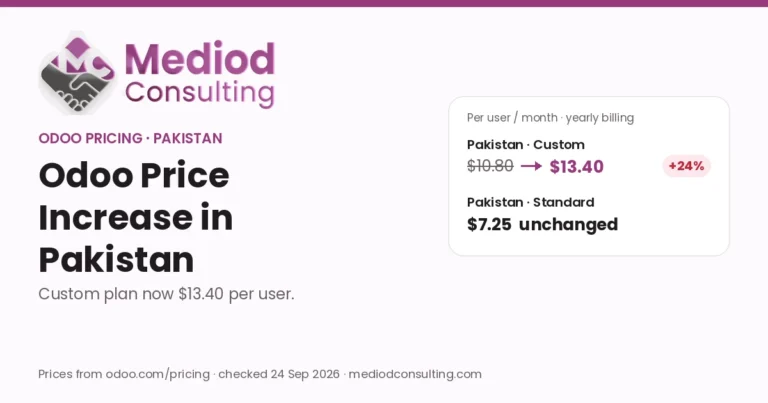
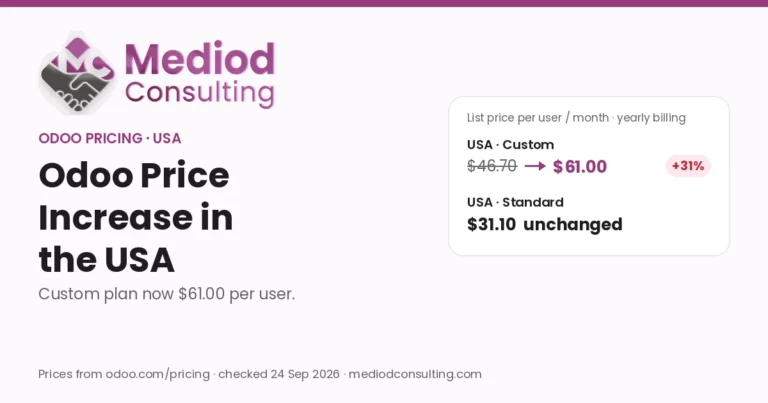
Odoo raised the Custom plan by 20–31% depending on the country (USA $61.00, Germany €44.90, Pakistan $13.40 per user/month); Standard is unchanged. See Odoo price increase 2026: what to consider.
Note: this post describes a pricing restructuring Odoo announced back at Odoo Experience 2022. The specific figures below reflect that announcement at the time — for current Odoo pricing, check odoo.com directly or contact Mediod Consulting for an up-to-date quote.
At Odoo Experience 2022, Odoo reworked its pricing structure to make it simpler and more accessible. It was a bold move for the company, but a reasonable one. Here’s the reasoning behind it.
How Odoo Restructured Its Pricing
Why did Odoo update its pricing?
Odoo’s stated goal is to give businesses easy access to the software they need to run and grow — including smaller companies with limited budgets. With every version, Odoo kept making its suite of business applications stronger, smarter, and faster, with new apps, features, and improved services. One piece was still missing: the pricing itself needed an update too.
What does optimal pricing look like?
Good pricing should line up with the value a customer actually gets from a product. By that measure, Odoo was worth relatively less to a single user than to a larger company with more complex needs and hundreds or thousands of users.
A smaller company can get by managing most of its business with less data integration and several disconnected applications. A larger company, on the other hand, can’t sustain its growth — or even function well — without automation and seamless application integration. So the logical pricing approach would scale the price level with the number of users a company has.
Odoo’s previous pricing structure actually worked the opposite way. On top of a per-user cost, there was also a cost for each application installed on the database.
In Europe, for example, single-user companies had an average monthly cost of €96. Meanwhile, 100-user companies had their per-application cost spread across those users, bringing their average monthly cost per user down to €20.
That old pricing structure was clearly far from optimal. Two problems stood out: there was a shortage of customers in the 1-5 user segment, and there was too little revenue from larger companies.
What’s the ideal price?
Once Odoo knew it needed to change the pricing, another question came up: how could the pricing be simplified even further? (Let’s be honest — the old structure wasn’t the easiest to understand.)
The simplest possible pricing formula, in short: one price, all applications.
That part was an easy call. The real question was what the right price actually was.
To figure that out, Odoo looked at competitor pricing to understand its own real value, starting with Microsoft Dynamics 365. But there was a catch: Odoo is much more than just an ERP — it’s also a CRM, Point of Sale, eCommerce platform, eSignature tool, HR system, and more. So Odoo added up what it would cost to piece together the equivalent from competitors, and here’s what that looked like:
ERP | Microsoft Dynamics 365 | $180 /user |
| CRM | Salesforce (Sales Cloud) | $75 /user |
| Point of Sale | Lightspeed | $119 /user |
| eCommerce | Shopify | $79 /user + 3% |
| eSign | DocuSign | $25 /user |
| HR | BambooHR | $6 /employee |
| Total | $484 /user |
And that’s not even the full range of Odoo applications — yet the equivalent value already added up to roughly $484/user/month across competitors. That figure doesn’t even include the cost of integrating all those separate tools together.
Simplifying to a single price was clearly the smart move. But Odoo also wanted to make itself far more accessible, to keep helping businesses of every size grow. So instead of pricing near that $484/user/month competitor-equivalent value, Odoo went the opposite direction:
Under €20/user/month for access to every Odoo application.
The New Pricing Plans
Under the new structure, every Odoo application is available at the price of a single one. The new pricing plans also include unlimited support, cloud hosting on Odoo Online, and maintenance.
There are two pricing plans covering every need: Standard and Custom. To lower the barrier to entry even further, Odoo also introduced a discount for the first year (or first few years, for multi-year agreements).
The One App Free Plan
Not exactly a pricing plan in the traditional sense (free isn’t a “price,” after all), the One App Free plan is still a popular option. It lets users access one application, free, on a database hosted in the cloud on Odoo Online, for an unlimited number of users, indefinitely.
Need full-featured accounting software? Free, unlimited users, indefinitely. Need a website, or an eCommerce setup? Free as well. Need Point of Sale for your shop? Also free, unless you install additional applications.
The Standard Plan
The Standard plan is the best fit for most businesses that don’t need custom development. With this plan, you get a standard database hosted in the cloud on Odoo Online, and you can install as many Odoo applications as you need. Pricing stays the same whether you install three apps or seventy — a flat cost per user, per month.
The Custom Plan
The Custom plan is best suited for businesses that need to manage multiple companies on a single database, or that need to customize their Odoo database with Odoo Studio, custom development (available only for databases hosted on Odoo.sh or On-Premise), or through the API.
What did this change mean for existing customers?
For most existing customers, this pricing change meant a cheaper subscription and access to every Odoo application instead of just a few — with the lower cost applied at their next subscription renewal. Good news across the board.
For most existing customers, this pricing change meant a cheaper subscription and access to every Odoo application instead of just a few — with the lower cost applied at their next subscription renewal. Good news across the board.
For the customers where this change would have meant a higher price, Odoo had good news for them too: they kept their existing cost. Their subscription moved to the new pricing model — giving them access to every Odoo application — but at a discount, so the cost of their subscription didn’t increase for their existing number of users.
Pricing details change over time, so don’t rely on the numbers above for a current quote. See our Odoo Subscription & Licensing Guidance for a current breakdown, or contact Mediod Consulting directly — mentioning us gets you a 22% discount on your Odoo subscription.
Frequently Asked Questions
Is Odoo pricing still one price for all applications?
Yes — the core structure described here (Standard and Custom plans, each giving access to the full app catalog for one per-user price) is still how Odoo prices Enterprise today. Exact rates change periodically, so always confirm current pricing before budgeting.
What’s the difference between the Standard and Custom plans?
Standard covers most businesses running a single company on Odoo Online. Custom adds multi-company support, Odoo Studio, and API/custom-development access — typically needed once a business outgrows out-of-the-box configuration.
Is the One App Free plan still available?
Yes — it remains a popular way to try a single Odoo app (like Accounting or CRM) for free, with unlimited users, indefinitely, before committing to a paid plan.
Get Started with Mediod Consulting
Want an accurate, current quote instead of relying on 2022 figures? Mediod Consulting is a certified Odoo Partner — book a free consultation and we’ll walk you through today’s actual pricing for your team size.
Prefer to see it yourself first? Start a free Odoo trial — sign up through that link and email info@mediodconsulting.com for your 22% partner discount, before or after you buy.