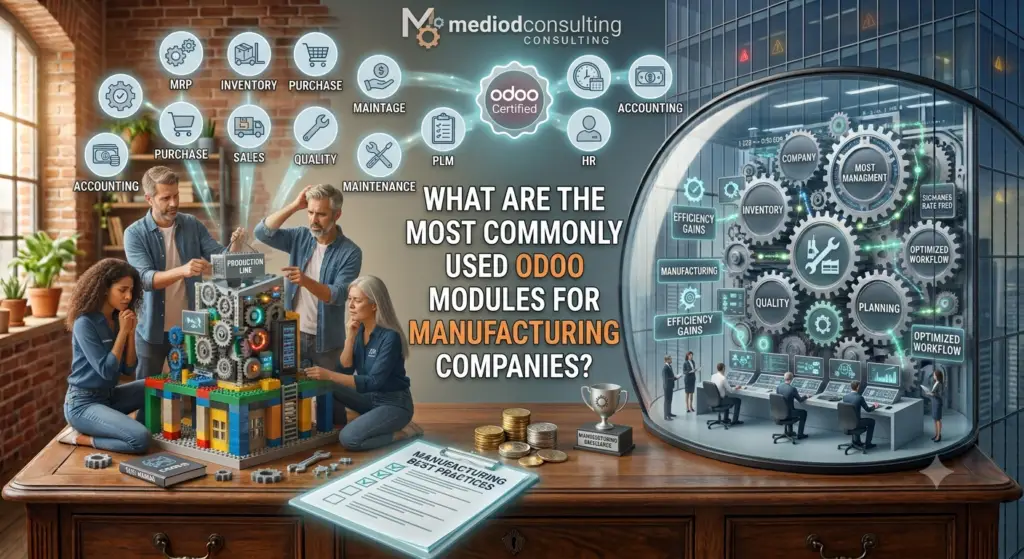
Manufacturing companies need more than a basic ERP system to manage production. They need visibility across sales, purchasing, inventory, manufacturing, quality, maintenance, employees, accounting, and supply chain operations.
This is where Odoo can be particularly useful.
With its integrated applications, Odoo allows manufacturers to connect different parts of the business in a single ERP platform. A sales order can trigger procurement or manufacturing, inventory can be updated as materials are consumed, finished products can be received into stock, and accounting can be connected to the resulting transactions.
But which Odoo modules for manufacturing companies are actually needed?
The answer depends on the type of manufacturing business, production processes, number of employees, warehouses, products, and level of automation.
In this guide, we look at the most commonly used Odoo manufacturing modules, what each module does, and how they work together to create an integrated manufacturing ERP system.
Why Do Manufacturing Companies Use Odoo?
Manufacturing businesses often manage information across multiple systems.
For example:
- Sales may use a CRM.
- Purchasing may use spreadsheets.
- Warehouse employees may use another inventory system.
- Production may use paper-based work orders.
- Accounting may use separate accounting software.
- Maintenance may be tracked manually.
- Quality inspections may be documented separately.
This creates information silos.
Odoo brings many of these processes together.
A typical manufacturing workflow can look like:
CRM → Sales → Manufacturing → Inventory → Purchase → Quality → Accounting
Instead of transferring information manually between departments, Odoo can connect these processes.
1. Odoo Manufacturing (MRP)
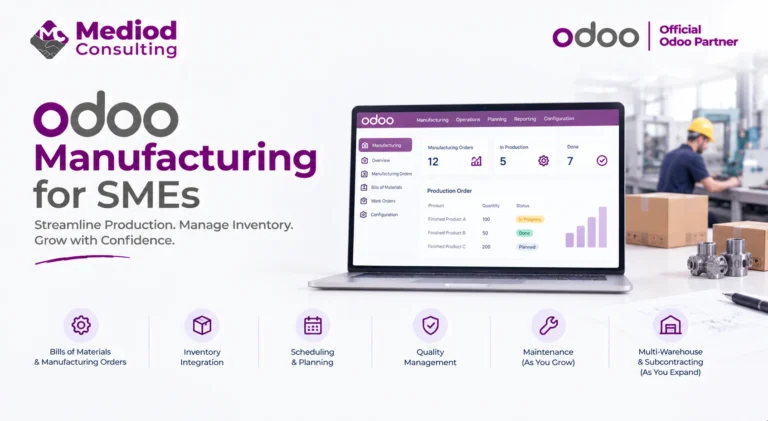
The Manufacturing application, commonly known as MRP, is usually the central Odoo module for manufacturing companies.
It helps businesses plan, manage, and track production.
The Manufacturing module can be used for:
- Manufacturing orders
- Bills of Materials (BoMs)
- Work centers
- Work orders
- Manufacturing routes
- Production planning
- Component consumption
- Finished products
- Scrap management
- Manufacturing costs
- Production scheduling
For example, suppose a company manufactures a machine containing 50 components.
A Bill of Materials can define:
Finished Product → Components → Subcomponents
When a manufacturing order is created, Odoo can determine which components are required.
This connects manufacturing directly with inventory and purchasing.
2. Odoo Inventory
Manufacturing cannot operate effectively without accurate inventory information.
The Odoo Inventory module manages stock across warehouses and locations.
Manufacturers commonly use it for:
- Raw materials
- Components
- Work-in-progress
- Finished products
- Stock transfers
- Receipts
- Deliveries
- Lots and serial numbers
- Inventory adjustments
- Reordering rules
- Warehouse operations
- Barcode scanning
Inventory and Manufacturing work closely together.
For example:
Purchase Order → Receipt → Raw Material Stock → Manufacturing Order → Finished Product → Delivery
This provides greater visibility into the movement of materials through the business.
3. Odoo Purchase
Manufacturers frequently purchase raw materials and components from multiple suppliers.
The Odoo Purchase module helps manage the procurement process.
It can be used for:
- RFQs
- Purchase orders
- Vendor pricing
- Supplier information
- Purchase agreements
- Vendor lead times
- Reordering
- Receipts
- Vendor bills
Manufacturing requirements can be connected to purchasing.
For example, if a production order requires a component that is not available in inventory, Odoo can help trigger procurement based on the configured replenishment rules.
This can reduce manual purchasing work and improve material planning.
4. Odoo Sales
Manufacturing often starts with customer demand.
The Odoo Sales module manages:
- Quotations
- Sales orders
- Pricelists
- Discounts
- Delivery
- Invoicing
- Customer information
Sales and Manufacturing can be connected so that a confirmed sales order can drive production requirements.
For example:
Customer Order → Manufacturing Requirement → Production → Finished Product → Delivery
This is particularly useful for companies that manufacture products after receiving customer orders.
5. Odoo CRM
For manufacturers with complex B2B sales cycles, Odoo CRM can be an important part of the overall ERP system.
CRM can help sales teams manage:
- Leads
- Opportunities
- Customer communications
- Activities
- Sales pipelines
- Expected revenue
- Follow-ups
For manufacturers selling customized products or industrial equipment, the sales process may take weeks or months.
CRM provides visibility before an opportunity becomes a sales order.
The complete process can become:
Lead → Opportunity → Quotation → Sales Order → Manufacturing → Delivery → Invoice
6. Odoo Quality
Quality management is critical for many manufacturing businesses.
The Odoo Quality module helps companies define and manage quality controls during manufacturing and inventory operations.
Common uses include:
- Quality checks
- Quality control points
- Inspection requirements
- Failure tracking
- Quality alerts
- Manufacturing inspections
- Receipt inspections
- Delivery inspections
For example, a manufacturer may require a quality inspection after a specific manufacturing operation.
Odoo can incorporate that inspection into the workflow rather than relying on a separate spreadsheet or paper form.
7. Odoo Maintenance
Manufacturing companies depend heavily on machinery and equipment.
Unexpected machine downtime can affect:
- Production schedules
- Delivery dates
- Labor utilization
- Manufacturing costs
- Customer satisfaction
The Odoo Maintenance module helps businesses manage equipment and maintenance activities.
It can support:
- Preventive maintenance
- Corrective maintenance
- Maintenance requests
- Equipment tracking
- Maintenance teams
- Maintenance schedules
- Equipment history
For example, a company can schedule preventive maintenance for a machine every 500 operating hours.
This can help reduce unexpected breakdowns.
8. Odoo PLM
Product Lifecycle Management, or PLM, is particularly useful for manufacturers that frequently modify their products.
The Odoo PLM module can help manage:
- Engineering Change Orders
- Bill of Materials changes
- Product revisions
- Approval workflows
- Manufacturing engineering processes
- Version control
Consider a manufacturer that changes a component in an existing product.
Instead of changing the Bill of Materials without documentation, the business can use a structured engineering change process.
This helps maintain a history of product changes.
9. Odoo Accounting
Manufacturing companies need accurate financial information about their operations.
The Odoo Accounting module connects financial transactions with other ERP processes.
It can manage:
- Customer invoices
- Vendor bills
- Payments
- Bank reconciliation
- Taxes
- Financial reporting
- Analytic accounting
- Budgets
- Multi-company accounting
- Multi-currency transactions
For manufacturers, accounting becomes particularly important when analyzing production costs.
Depending on the configuration, businesses can use Odoo to gain greater visibility into:
- Material costs
- Labor costs
- Manufacturing costs
- Inventory valuation
- Product profitability
Accounting should therefore be considered an important part of a manufacturing ERP implementation rather than a separate system.
10. Odoo Barcode
Manufacturing and warehouse employees often need to process large numbers of products and components.
The Odoo Barcode module can simplify warehouse and manufacturing operations through barcode scanning.
Common uses include:
- Receiving materials
- Internal transfers
- Picking
- Delivery
- Inventory counting
- Lot tracking
- Serial number tracking
- Manufacturing operations
Barcode workflows can reduce manual data entry and improve inventory accuracy.
For manufacturers with high warehouse activity, barcode scanning can be one of the most valuable additions to an Odoo implementation.
11. Odoo Employees
Manufacturing companies also need to manage their workforce.
The Employees module provides a central employee database.
It can contain information such as:
- Employee records
- Departments
- Job positions
- Work information
- Managers
- Skills
- Documents
When combined with other HR applications, it can become part of a broader manufacturing workforce management system.
12. Odoo Timesheets
Labor is an important manufacturing cost.
The Odoo Timesheets module can help businesses track time spent on:
- Manufacturing activities
- Projects
- Work orders
- Maintenance
- Other operational tasks
For companies where labor represents a significant portion of production costs, time tracking can provide useful information for cost analysis and productivity measurement.
13. Odoo Planning
Manufacturing companies need to plan people, resources, and production capacity.
The Odoo Planning module can help schedule employees and activities.
Manufacturers can use planning for:
- Employee schedules
- Work shifts
- Production-related activities
- Resource allocation
- Availability management
Planning becomes especially important when businesses operate multiple shifts or have limited production capacity.
14. Odoo Project
Not every manufacturing company produces identical products.
Some businesses manufacture:
- Custom machinery
- Industrial equipment
- Construction components
- Engineering products
- Made-to-order systems
These businesses may combine manufacturing with project-based work.
The Odoo Project module can help manage tasks, deadlines, project activities, and customer-specific work.
For example:
Sales Order → Project → Engineering → Procurement → Manufacturing → Delivery
This can be useful for engineer-to-order businesses.
15. Odoo Expenses
Employees involved in manufacturing, engineering, procurement, and sales may incur business expenses.
The Odoo Expenses module can manage:
- Employee expenses
- Expense reports
- Approvals
- Reimbursements
- Accounting integration
Although it is not a manufacturing-specific application, it can become part of the overall ERP environment.
16. Odoo Subcontracting
For manufacturers who outsource part of their production to third parties, this module tracks components sent to subcontractors and finished or semi-finished goods received back, keeping that outsourced work visible in the same inventory and planning system. Detail in our Subcontracting guide.
Which Odoo Modules Are Essential for Manufacturing?
Not every manufacturer needs every Odoo application.
A typical manufacturing implementation might start with:
Core Manufacturing Setup
- Manufacturing
- Inventory
- Purchase
- Sales
- Accounting
Advanced Manufacturing Setup
- Quality
- Maintenance
- PLM
- Barcode
- Planning
Business and Workforce Setup
- CRM
- Employees
- Timesheets
- Expenses
- Project
The correct combination depends on the company’s processes.
Example: Odoo Manufacturing Workflow
Consider a company manufacturing industrial equipment.
A customer contacts the sales team.
Step 1 — CRM
The lead becomes an opportunity.
Step 2 — Sales
The salesperson creates a quotation.
Step 3 — Sales Order
The customer confirms the order.
Step 4 — Manufacturing
Odoo creates or triggers the required manufacturing process.
Step 5 — Inventory
The system checks whether raw materials are available.
Step 6 — Purchase
Missing components are procured from suppliers.
Step 7 — Manufacturing
Production workers manufacture the finished product.
Step 8 — Quality
The product goes through the required quality checks.
Step 9 — Inventory
The finished product is added to stock.
Step 10 — Delivery
The product is delivered to the customer.
Step 11 — Accounting
The related invoice and financial transactions are processed.
This is the value of an integrated ERP system.
Instead of managing each stage separately, Odoo can connect the entire process.
Odoo Manufacturing for Small Businesses
Small manufacturing companies do not necessarily need a complicated ERP implementation.
A smaller manufacturer may start with:
- Manufacturing
- Inventory
- Purchase
- Sales
- Accounting
Additional applications can be introduced later.
For example:
Phase 1
Sales + Purchase + Inventory + Accounting + Manufacturing
Phase 2
Quality + Maintenance + Barcode
Phase 3
PLM + Advanced Planning + Automation
This phased approach can reduce implementation complexity and allow employees to adopt Odoo gradually.
Odoo Manufacturing for Large Companies
Larger manufacturers may require a more comprehensive implementation.
Requirements can include:
- Multiple companies
- Multiple warehouses
- Multiple currencies
- Advanced inventory
- Manufacturing planning
- Quality management
- Maintenance
- Product lifecycle management
- Barcode operations
- Advanced reporting
- Manufacturing integrations
- External logistics systems
- Complex accounting
Large implementations require careful process analysis before configuring Odoo.
Simply installing more applications does not automatically create a better ERP system.
Odoo Manufacturing for Make-to-Order Businesses
Make-to-order manufacturing businesses produce goods based on customer demand.
A typical workflow may be:
Sales Order → Procurement → Manufacturing → Quality → Delivery
Odoo can connect these operations so that production is aligned with actual customer requirements.
This can be useful for manufacturers that want to minimize finished-goods inventory.
Odoo Manufacturing for Make-to-Stock Businesses
Make-to-stock manufacturers produce products based on expected demand.
These companies need strong:
- Inventory management
- Forecasting
- Reordering
- Manufacturing planning
- Procurement
Odoo can connect inventory levels with replenishment and manufacturing processes.
This can help businesses maintain appropriate stock levels while avoiding unnecessary inventory.
Odoo Manufacturing and Automation
Manufacturing companies often have repetitive processes that can be automated.
Examples include:
- Automatic procurement
- Reordering rules
- Automated manufacturing orders
- Automated emails
- Approval workflows
- Inventory alerts
- Quality checks
- Scheduled activities
- Reporting
Odoo automation can reduce manual work and help employees focus on higher-value activities.
However, automation should be introduced after the underlying process has been properly designed.
Odoo Manufacturing and AI
AI is becoming increasingly relevant to ERP systems.
Manufacturers can explore AI for areas such as:
- Demand forecasting
- Production planning
- Predictive maintenance
- Document processing
- Automated data entry
- Customer communication
- Operational reporting
- AI assistants
However, AI should complement a well-designed ERP foundation.
If the underlying product, inventory, purchasing, and manufacturing data is inaccurate, AI cannot solve the fundamental data problem.
Odoo Manufacturing Implementation: Where Should You Start?
Before implementing Odoo for manufacturing, document your current processes.
Start by answering questions such as:
- How are products manufactured?
- Do you use Bills of Materials?
- How many production stages exist?
- Do you use work centers?
- How are raw materials purchased?
- How is inventory tracked?
- Do products require quality inspections?
- How is machine maintenance handled?
- Are products serialized?
- Do you manufacture to order or to stock?
- How are production costs calculated?
- Do customers require customized products?
- Which external systems need to integrate with Odoo?
The answers determine which Odoo applications should be included.
Common Mistakes When Implementing Odoo for Manufacturing
Manufacturing ERP projects can become complicated if implementation is not planned carefully.
Common mistakes include:
Implementing Too Many Modules at Once
More modules do not necessarily mean a better implementation.
Ignoring Existing Manufacturing Processes
Odoo should be configured around real business requirements.
Poor Bill of Materials Data
Incorrect BoMs can create problems throughout manufacturing and inventory.
Not Training Production Employees
Warehouse and production users need practical training.
Insufficient Testing
Test complete manufacturing workflows before go-live.
Over-Customization
Use standard Odoo functionality wherever practical.
Poor Master Data
Products, units of measure, suppliers, BoMs, and inventory data should be clean.
Ignoring Costing
Manufacturing costs should be validated before relying on financial reports.
How Mediod Consulting Can Help With Odoo Manufacturing
Implementing Odoo for manufacturing requires more than activating the Manufacturing application.
At Mediod Consulting, we can help manufacturers analyze their processes and design an Odoo environment around their operational requirements.
Our Odoo manufacturing services can include:
- Manufacturing process analysis
- Odoo MRP implementation
- Bill of Materials configuration
- Work center configuration
- Manufacturing workflows
- Inventory implementation
- Purchase and procurement setup
- Quality management
- Maintenance management
- PLM configuration
- Barcode implementation
- Manufacturing automation
- Accounting integration
- Data migration
- Custom Odoo development
- Third-party integrations
- User training
- Odoo support and maintenance
We can also help businesses determine which modules should be implemented immediately and which can be introduced later.
Odoo Manufacturing Implementation in the USA
Manufacturing companies in the United States may have requirements around:
- Sales tax
- Multiple warehouses
- Multi-state operations
- Manufacturing costs
- Inventory valuation
- Shipping integrations
- eCommerce
- Accounting integrations
- External manufacturing systems
An Odoo manufacturing implementation in the USA should therefore be designed around the company’s actual supply chain and financial processes.
The right modules depend on whether the business is make-to-stock, make-to-order, engineer-to-order, or operates a combination of manufacturing models.
Odoo Manufacturing Implementation in Germany
Manufacturers operating in Germany may require additional consideration for:
- German accounting localization
- VAT
- DATEV
- SEPA
- Inventory valuation
- Manufacturing costing
- Multiple companies
- European supply chains
An Odoo manufacturing implementation in Germany should connect production with accounting, inventory, purchasing, sales, and the company’s reporting requirements.
For German manufacturers, it is particularly important to validate accounting and localization requirements before going live.
Ready to see how Odoo’s manufacturing apps handle your actual bills of materials and work orders? No dedicated manufacturing trial link exists, but talk to Mediod Consulting’s team about a scoped demo using your own production data.
Frequently Asked Questions
What is the most important Odoo module for manufacturing?
The Manufacturing or MRP module is usually the central application for production management. However, it normally works together with Inventory, Purchase, Sales, and Accounting.
Which Odoo modules are best for a manufacturing company?
There is no universal module combination. A typical manufacturer may need Manufacturing, Inventory, Purchase, Sales, and Accounting, with Quality, Maintenance, PLM, Barcode, and Planning added depending on the business.
Is Odoo good for manufacturing?
Yes. Odoo provides integrated manufacturing, inventory, purchasing, quality, maintenance, PLM, sales, and accounting functionality. The success of the implementation depends heavily on proper configuration and process design.
Does Odoo support Bill of Materials?
Yes. Bills of Materials are a core part of Odoo Manufacturing and define the components and structure required to manufacture products.
Can Odoo handle multiple manufacturing locations?
Yes. Odoo can be configured for multiple warehouses, locations, and companies depending on the business structure and requirements.
Can Odoo manage manufacturing quality checks?
Yes. The Quality application can be integrated with manufacturing and inventory workflows to manage inspections and quality control processes.
Can Odoo manage machine maintenance?
Yes. The Maintenance application can manage equipment, preventive maintenance, corrective maintenance, and maintenance requests.
Is Odoo suitable for small manufacturing companies?
Yes. Small manufacturers can start with core applications and expand the implementation as the business grows.
Can Odoo integrate manufacturing with accounting?
Yes. Odoo can connect manufacturing and inventory operations with accounting, allowing businesses to build an integrated ERP environment.
Do all manufacturing modules require Enterprise edition?
Core Manufacturing works in Community edition. Quality, Maintenance, and PLM have deeper functionality in Enterprise, with some basic capability available in Community.
Can these modules be added incrementally after initial implementation?
Yes, and this is the approach we generally recommend — implement core Manufacturing first, then add specialized modules as specific needs are confirmed.
Final Thoughts
The best Odoo modules for manufacturing companies depend on how the business operates.
For many manufacturers, the core foundation is:
Manufacturing + Inventory + Purchase + Sales + Accounting
From there, businesses can add:
Quality + Maintenance + PLM + Barcode + Planning
And depending on the broader business requirements:
CRM + Project + Employees + Timesheets + Expenses + eCommerce
The key is not to implement every available application.
The goal is to build an Odoo ERP system that accurately represents your manufacturing processes, provides reliable data, reduces manual work, and can scale with the business.
If you are considering Odoo for manufacturing, Mediod Consulting can help you evaluate your current processes, select the right Odoo applications, configure manufacturing workflows, migrate data, develop required customizations, and support your team through implementation and go-live.
Planning an Odoo manufacturing implementation in the USA, Germany, or elsewhere? Contact Mediod Consulting to discuss your requirements, or explore our development and customization services for manufacturing-specific configuration work.