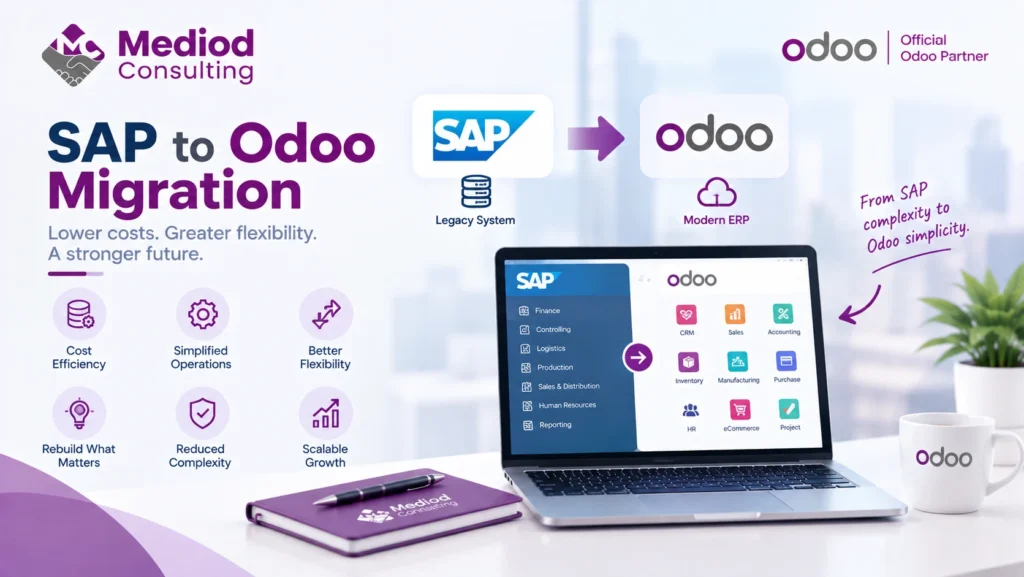
Migrating from SAP to Odoo is a bigger undertaking than most ERP migrations, reflecting SAP’s typical scale and depth of implementation — but it’s also one of the more common migrations we see, usually driven by cost and a desire for more implementation flexibility.
Why businesses move from SAP to Odoo
SAP’s licensing and implementation costs are substantial, and businesses — particularly small and mid-sized ones that adopted SAP or inherited an SAP environment — increasingly look for alternatives that deliver comparable operational connectivity without SAP’s cost structure or the specialized (and expensive) expertise SAP customization typically requires.
What makes SAP migrations more complex
SAP implementations tend to be deeply customized, often with years of accumulated business logic built directly into the SAP environment. Migrating away means carefully identifying what customizations actually reflect genuine business requirements (which need to be rebuilt or reconfigured in Odoo) versus what’s simply how SAP happened to be set up (which may not need to carry forward at all).
Data migration scope
A SAP-to-Odoo migration typically involves master data (customers, vendors, materials), financial history, inventory data, and open transactions. Given SAP’s typical data volume and complexity, thorough data mapping and validation planning matters even more here than in a typical migration.
Phasing a SAP migration
Given the scale involved, we generally recommend a phased approach for SAP-to-Odoo migrations — starting with a specific business unit, product line, or geography rather than attempting a full cutover at once. This reduces risk and lets you validate the approach before committing the entire organization to the new system.
Rebuilding versus replicating SAP customizations
A genuine opportunity in a SAP migration is reassessing whether every existing customization is actually still needed — SAP environments accumulate complexity over years, and a migration is a natural point to simplify rather than faithfully replicating every piece of accumulated customization in the new system.
Frequently Asked Questions
How long does a SAP to Odoo migration typically take?
Given typical SAP deployment scale and complexity, these migrations often take several months for a full transition, particularly with a phased approach across business units.
Can Odoo replicate everything our SAP setup does?
Often not identically, but frequently more capability than needed once genuine requirements are separated from accumulated legacy customization — this assessment is part of the migration planning process.
Is a phased migration from SAP riskier than a full cutover?
Generally the opposite — phasing reduces risk by letting you validate the approach on a smaller scope before committing the full organization, catching issues while the blast radius is still contained.
Migrate From SAP Without Losing What Actually Matters
A SAP migration is a chance to simplify as much as it is a platform change — worth approaching deliberately. Talk to Mediod Consulting about migrating from SAP to Odoo.