“Migration” and “implementation” get used somewhat interchangeably in conversations about moving to Odoo, but they describe genuinely different starting points and different kinds of projects. Knowing which one actually describes your situation changes how the project should be scoped.
What implementation means
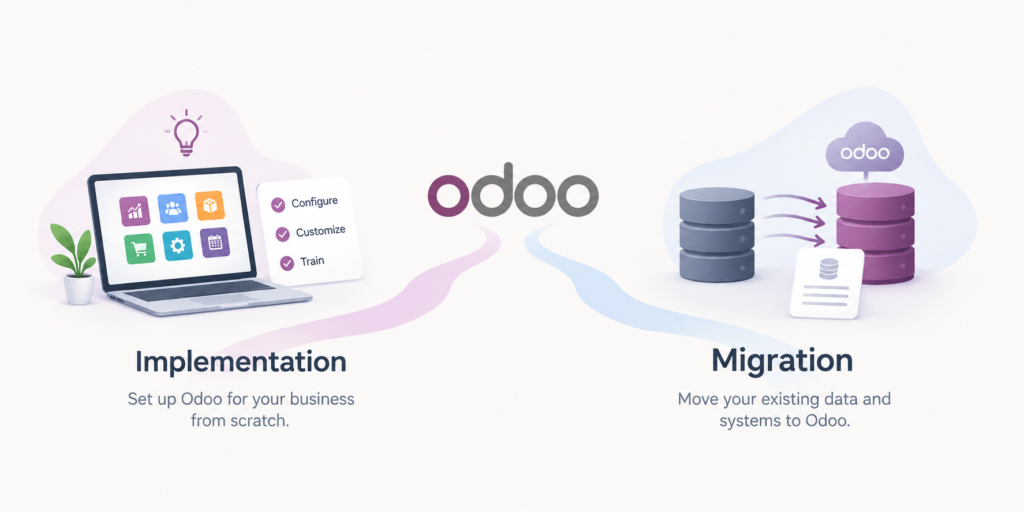
Implementation is setting up Odoo for a business that’s either starting fresh (no existing system of record) or moving from something informal enough that there’s no structured data to transfer — configuring modules, defining workflows, and training a team on a genuinely new system without a significant existing dataset to bring over.
What migration means
Migration is moving from an existing structured system — another ERP, an older Odoo version, or a well-established set of business tools — into Odoo, with a real body of existing data (customers, transactions, historical records) that needs to transfer accurately. See our Database Migration guide for the technical mechanics involved.
Why the distinction affects project scope
An implementation project’s complexity centers on configuration and change management — getting the new system set up correctly and getting a team trained and comfortable with new workflows. A migration project adds a whole additional dimension: data mapping, cleaning, transfer, and validation, on top of the same configuration and change management work implementation requires.
Where the two overlap
In practice, many projects are both — moving from an old system does involve migration, but it also requires implementation decisions about how Odoo should be configured to fit the business, which isn’t automatically inherited from the old system’s setup. A well-scoped project separates these two dimensions clearly rather than treating “migration” as if it automatically defines all the configuration decisions too.
How this affects timeline and cost
A pure implementation, without significant data migration, is generally faster and more predictable than a migration project of comparable business complexity, simply because there’s one less major risk dimension (data accuracy and transfer) to manage. This is worth understanding clearly when comparing timeline estimates between businesses in different starting situations.
Frequently Asked Questions
Is a version upgrade considered a migration or an implementation?
A migration — you’re moving existing data and configuration from one Odoo version to another, which is exactly the “existing structured system” scenario migration describes.
Can a project be planned as implementation-only if there’s some existing data?
If the existing data is minimal or informal enough (a small spreadsheet, for example), it might be handled as a lightweight import within an implementation project rather than requiring a full migration approach — this is a judgment call worth discussing directly.
Does migration always cost more than implementation?
Generally yes for comparable business complexity, since migration adds data mapping, cleaning, and validation work that implementation alone doesn’t require.
Scope Your Project Based on Your Actual Starting Point
Understanding whether you need migration, implementation, or both leads to a more accurate project scope and estimate. Talk to Mediod Consulting about scoping your specific move to Odoo correctly.