Most manufacturers outsource at least some part of production — a specialized process, overflow capacity during peak demand, or a step that doesn’t make sense to bring in-house. Odoo’s subcontracting functionality keeps that outsourced work visible in the same system as everything you produce yourself.
What subcontracting actually involves
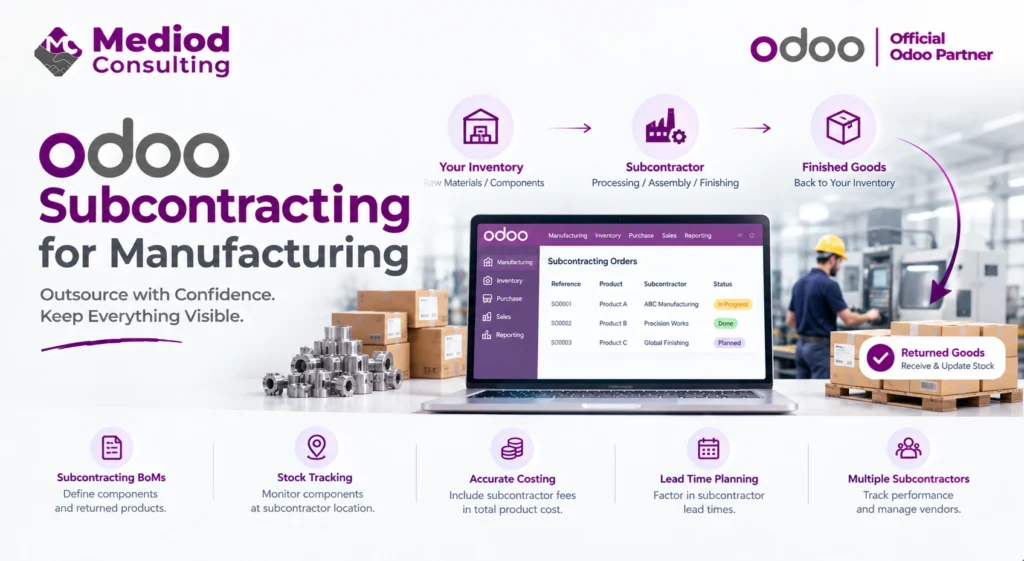
Subcontracting means sending components or raw materials to a third-party manufacturer, who performs a specific operation (assembly, a specialized process, finishing) and returns the resulting semi-finished or finished goods. Without proper tracking, this outsourced step becomes a visibility gap — inventory technically leaves your control but the business still needs to plan around it as if it were in-house production.
How Odoo tracks subcontracted operations
A subcontracting BoM defines what components get sent to the subcontractor and what finished or semi-finished product comes back. Odoo tracks the component stock as transferred to the subcontractor’s location (rather than simply “gone”), and the returned goods are received back into your own inventory once the subcontractor completes the work — keeping the full chain visible rather than treating it as a black box.
Costing subcontracted work
The subcontractor’s fee for their portion of the work gets factored into the overall product cost alongside your own components and labor, giving an accurate total cost of goods even when part of production happens outside your own facility.
Planning around subcontractor lead times
Subcontracted operations have their own lead time — the time for the subcontractor to receive components, perform the work, and ship the result back — which needs to factor into your overall production planning the same way any other production step’s lead time does. Underestimating subcontractor lead time is a common source of delivery date surprises.
Managing multiple subcontractors
For manufacturers using several different subcontractors for different operations or products, tracking which subcontractor handles which step, their respective lead times, and their performance history helps with both planning and vendor management — informing decisions about which subcontractor to use for future orders based on actual track record.
Frequently Asked Questions
Does subcontracting tracking require the subcontractor to use Odoo too?
No, subcontracting is tracked entirely from your side — the subcontractor doesn’t need Odoo access, though some setups do share basic order and status information electronically for smoother coordination.
Can subcontracted and in-house production use the same product?
Yes, a product can have both an in-house BoM and a subcontracted BoM, letting you flex between the two based on capacity, cost, or timing needs.
How does subcontracting affect inventory valuation?
Components sent to a subcontractor are tracked at a specific location representing that transfer, and the subcontractor’s fee is added to the cost when the finished goods are received back, keeping valuation accurate throughout the process.
Keep Outsourced Production Visible and Planned
Properly tracked subcontracting closes the visibility gap that outsourced production otherwise creates. Talk to Mediod Consulting about setting up subcontracting tracking for your manufacturing operation.