Knowing what a product actually costs to manufacture — not roughly, but accurately — is foundational to pricing decisions, margin analysis, and knowing which products are genuinely profitable. Odoo calculates manufacturing costs from real production data rather than requiring manual estimation.
What goes into manufacturing cost
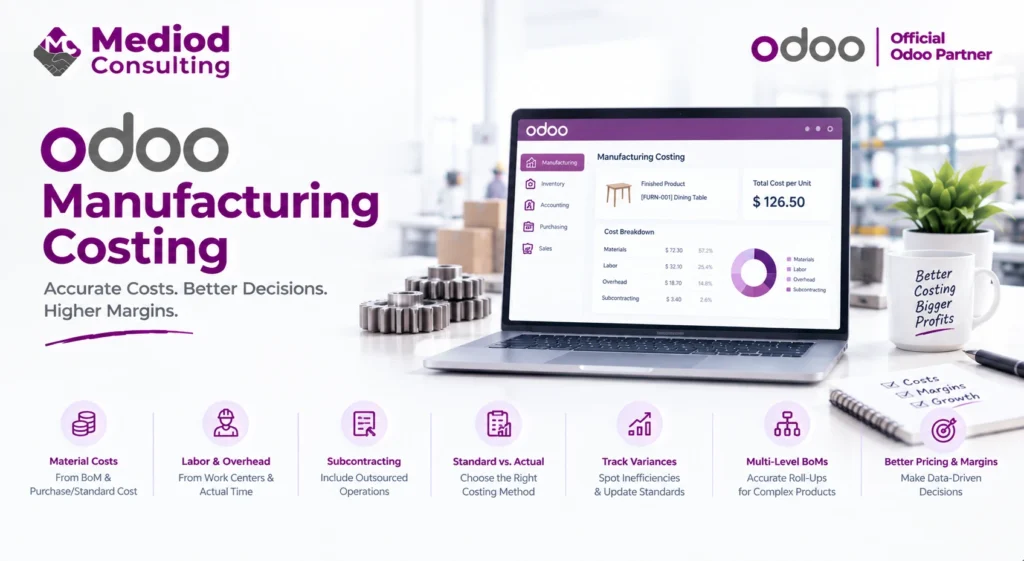
Odoo’s manufacturing cost calculation combines three components: material costs (from the bill of materials, based on your components’ purchase or standard cost), labor and overhead costs (from work center hourly rates, based on actual time spent during production), and any subcontracting fees if part of the process is outsourced. Together these give a total cost per unit produced.
Standard costing versus actual costing
Standard costing uses predefined cost estimates for materials and operations, giving consistent, predictable costs useful for pricing and budgeting, but not necessarily reflecting real-time cost fluctuations. Actual costing calculates cost based on real transaction data — actual material costs at time of consumption, actual time spent at each work center — giving more accurate but more variable cost figures. Odoo supports both approaches, and which one fits depends on how much cost stability versus cost accuracy matters for your specific business.
How variance gets tracked
The difference between standard (planned) cost and actual cost — a cost variance — is worth tracking deliberately, since consistent variances point to either an outdated standard cost that needs updating, or a real operational inefficiency worth investigating (more material waste than planned, work taking longer than the standard time allows).
Costing multi-level BoMs
For products built from sub-assemblies that are themselves manufactured, Odoo calculates cost by rolling up through each level — the cost of a sub-assembly becomes a component cost in the parent product’s calculation, cascading accurately through however many levels your BoM structure has.
Using cost data for pricing and margin decisions
Accurate manufacturing cost is the foundation for real margin analysis — without it, pricing decisions are essentially guesses. Regularly reviewing cost data against actual sales prices helps identify products that look profitable on paper but aren’t once true manufacturing cost is accounted for accurately.
Frequently Asked Questions
How often should standard costs be updated?
This depends on how much material and labor costs fluctuate in your industry — a periodic review (quarterly is common) keeps standard costs reasonably aligned with reality without constant manual adjustment.
Does Odoo account for scrap or waste in manufacturing costing?
Yes, scrap and waste can be tracked and factored into actual cost calculations, giving a more realistic cost figure than one that assumes zero material loss.
Can manufacturing costing handle products with highly variable material costs?
Yes, particularly with actual costing, which reflects real material costs at time of consumption rather than a fixed standard that may not match current market prices.
Know What Your Products Actually Cost to Make
Accurate manufacturing costing turns pricing and margin decisions from guesswork into something you can actually rely on. Talk to Mediod Consulting about setting up accurate manufacturing costing in Odoo.