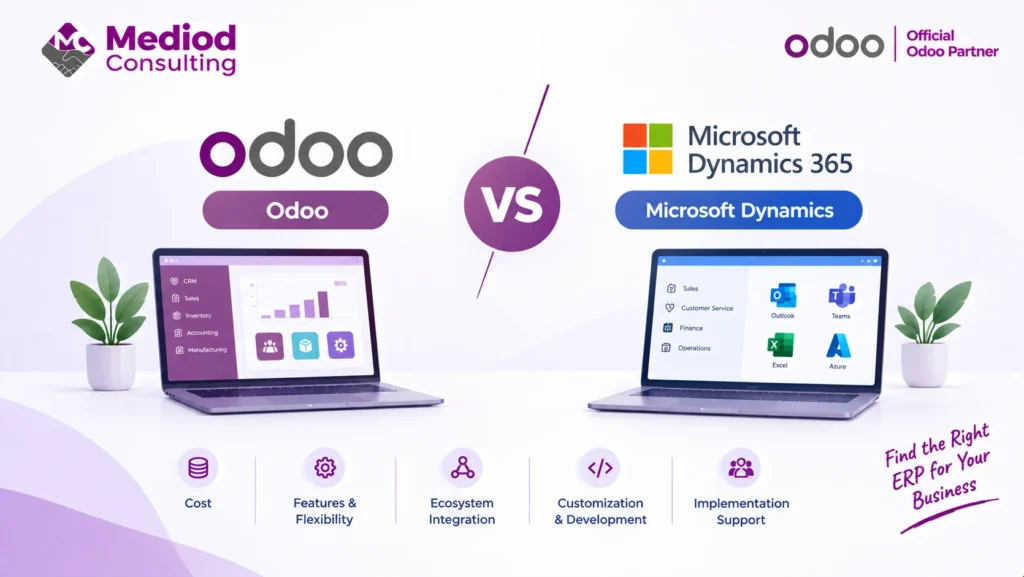
Microsoft Dynamics 365 carries the weight of Microsoft’s broader ecosystem — Office 365, Teams, Azure — which makes it a natural default for businesses already deeply invested in Microsoft tools. The comparison with Odoo comes down to whether that ecosystem alignment outweighs Odoo’s cost and flexibility advantages.
What Dynamics 365 offers
Dynamics 365’s biggest practical advantage is tight integration with the Microsoft tools many businesses already use daily — Outlook, Excel, Teams — reducing friction for teams already living in that ecosystem. It also benefits from Microsoft’s broad partner network and enterprise credibility, relevant for businesses whose stakeholders expect established, recognizable enterprise software.
Where Odoo’s approach differs
Cost is the most immediate difference — Dynamics 365 pricing scales per user across its various modules (Business Central for SMBs, Finance and Operations for larger enterprises), typically at a meaningfully higher cost than Odoo’s free Community edition or more accessible Enterprise pricing. Odoo’s modular, start-narrow-and-expand implementation approach also tends to be faster and lower-risk than a typical Dynamics 365 rollout, which often involves more upfront scoping given its enterprise positioning.
Ecosystem integration considerations
If your business runs heavily on Microsoft tools already, Dynamics 365’s native integration genuinely reduces friction in ways that connecting Odoo to the same Microsoft tools (via separate integrations) doesn’t fully replicate. This is a real, legitimate factor worth weighing — not just brand loyalty, but actual day-to-day workflow smoothness for teams already in that ecosystem.
Customization and development cost
Odoo’s larger open-source developer community and more accessible codebase generally make custom development less expensive than customizing Dynamics 365, which typically requires Microsoft-specific development expertise commanding premium rates, similar to the SAP comparison in this respect.
When Dynamics 365 might be the better fit
Businesses deeply embedded in the Microsoft ecosystem, where native Teams, Outlook, and Excel integration meaningfully improves daily workflow, or businesses whose stakeholders specifically expect Microsoft enterprise software, may find Dynamics 365’s higher cost justified by these factors.
Frequently Asked Questions
Does Odoo integrate with Microsoft Outlook and Teams?
Yes, through available integrations, though the integration isn’t as deeply native as Dynamics 365’s built-in Microsoft ecosystem connectivity.
Which Dynamics 365 product should be compared to Odoo?
Business Central is the most comparable product for small and mid-sized businesses; Finance and Operations targets larger enterprises and is a different comparison scale entirely.
Is switching from Dynamics 365 to Odoo disruptive for a Microsoft-heavy team?
It requires planning around both data migration and workflow adjustment, since teams used to native Microsoft integration will need to adapt to a different (though still functional) integration approach.
Weigh Ecosystem Fit Against Cost and Flexibility
The right choice depends on how much your team’s daily workflow actually depends on native Microsoft integration. Talk to Mediod Consulting about comparing Odoo and Microsoft Dynamics for your business.