NetSuite has built a strong position in the cloud ERP market, particularly among fast-growing mid-market companies backed by venture or private equity investment. It’s a common comparison point for businesses evaluating Odoo at a similar scale and growth trajectory.
What NetSuite offers
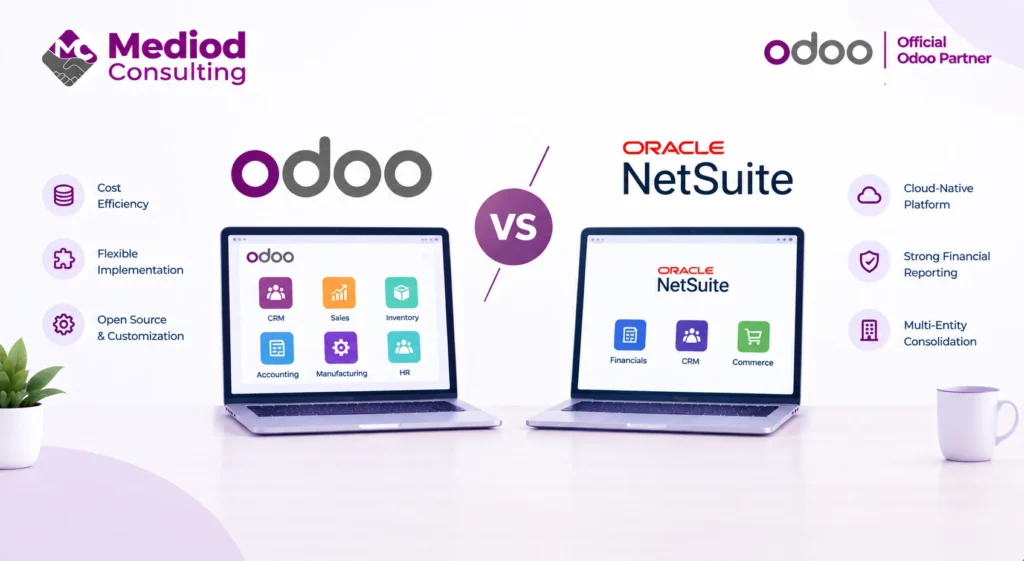
NetSuite is a mature, fully cloud-native ERP with strong financial management depth, particularly valued by finance teams and investors familiar with its reporting capabilities, and broad functionality across financials, CRM, and ecommerce within one Oracle-owned platform.
Where Odoo’s approach differs
The most immediate difference is cost structure — NetSuite’s licensing is typically priced per user with additional module costs, often making it a meaningfully larger recurring expense than Odoo, whose Community edition is free and even Enterprise pricing tends to be more accessible. Implementation approach also differs: Odoo’s modular structure supports starting narrow and expanding, while NetSuite implementations often involve a broader initial scope given its positioning as a comprehensive cloud ERP from the outset.
Financial reporting depth
NetSuite has a strong reputation specifically for financial reporting and multi-entity consolidation, built up through years of serving finance-heavy, investor-backed businesses. Odoo’s financial reporting has matured significantly and covers most standard needs well, though businesses with very complex multi-entity consolidation requirements should evaluate this specific capability carefully against their needs.
Deployment and hosting
NetSuite is exclusively cloud-hosted by Oracle with no self-hosting option. Odoo offers Odoo Online, Odoo.sh, and self-hosted deployment, giving more flexibility for businesses with specific data residency or infrastructure control requirements.
When NetSuite might be the better fit
Fast-growing, investor-backed businesses where NetSuite’s financial reporting reputation carries weight with investors or board members, or businesses with complex multi-entity consolidation needs that NetSuite handles particularly well, may find its higher cost justified by these specific factors.
Frequently Asked Questions
Is NetSuite significantly more expensive than Odoo?
Generally yes — NetSuite’s per-user, per-module pricing tends to add up to a higher total cost than Odoo, particularly for growing teams, though exact costs depend on specific configuration and negotiated terms.
Does Odoo support multi-entity consolidation like NetSuite?
Yes, through multi-company functionality, though very complex consolidation scenarios are worth evaluating specifically against your requirements before assuming either platform’s default capability is sufficient.
Can a business migrate from NetSuite to Odoo?
Yes, though it requires careful planning around financial data migration and process mapping, given NetSuite implementations often involve significant historical financial data.
Compare the Real Cost and Fit for Your Growth Stage
The right choice depends on your specific financial reporting needs and how much you’re willing to pay for NetSuite’s particular strengths. Talk to Mediod Consulting about comparing Odoo and NetSuite for your business.