Production planning is where demand, capacity, and materials all have to line up — get it wrong and you’re either sitting on excess inventory or scrambling to meet orders you can’t fulfill on time. Odoo gives manufacturers several tools to manage this, matched to different levels of complexity.
Demand sources feeding production planning
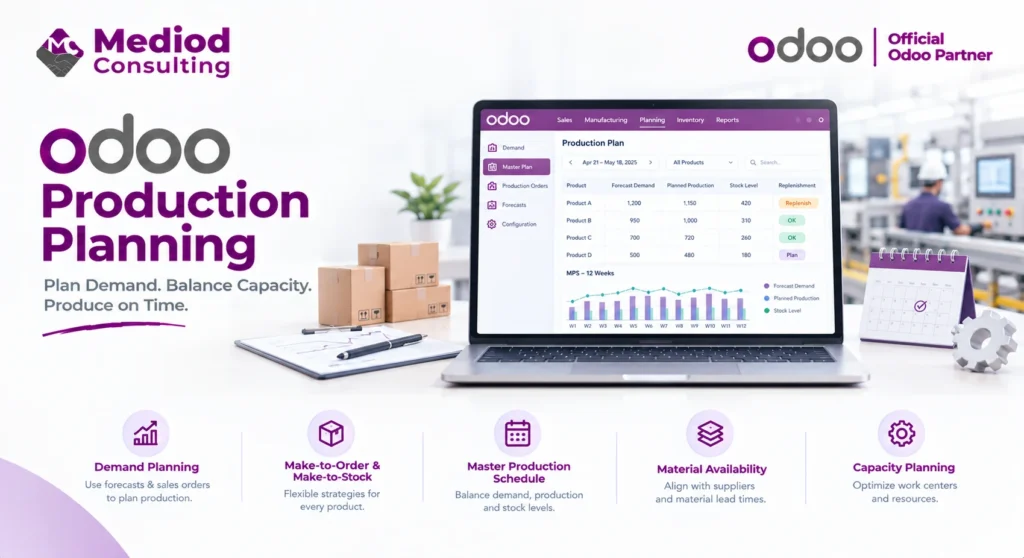
Production plans typically draw from a combination of confirmed sales orders, sales forecasts, and minimum stock rules — Odoo can plan production reactively (triggered by actual orders) or proactively (based on forecasted demand), and most manufacturers use some blend of both depending on the product.
Make-to-order versus make-to-stock planning
Make-to-order production starts only once a confirmed sales order exists, minimizing finished goods inventory but extending customer lead time. Make-to-stock production builds ahead of confirmed demand based on forecasts, reducing customer wait time but carrying inventory risk if forecasts are wrong. Odoo supports configuring this per product, letting a manufacturer mix strategies based on each product’s demand predictability and margin for held inventory.
The Master Production Schedule
For manufacturers needing a higher-level view across multiple products and time periods, Odoo’s Master Production Schedule (MPS) provides a planning view showing forecasted demand, planned production, and resulting stock levels across a defined horizon — useful for balancing production across products sharing constrained capacity or materials.
Handling demand variability
Real demand rarely matches forecasts exactly, and production planning needs to account for this — safety stock levels, reorder points with appropriate buffers, and periodic forecast review all help absorb variability without either overproducing or stalling out when demand spikes unexpectedly.
Coordinating with material availability
Production planning is only as good as the material availability it’s built on — a production plan that doesn’t account for supplier lead times or material constraints looks achievable on paper but fails in practice. This is where production planning and MRP’s material requirements calculations need to work together rather than being treated as separate concerns.
Frequently Asked Questions
Can Odoo production planning account for seasonal demand?
Yes, through forecasting configured with seasonal patterns and appropriately adjusted safety stock levels for peak periods.
How far in advance should production be planned?
This depends on your production lead times and material lead times — the planning horizon needs to extend at least as far as your longest lead time to be genuinely useful.
Does production planning integrate with sales forecasting?
Yes, sales forecasts can feed directly into production planning, giving manufacturing visibility into expected demand before orders are actually confirmed.
Plan Production That Matches Real Demand and Capacity
Good production planning balances customer lead time, inventory cost, and capacity constraints deliberately, not by accident. Talk to Mediod Consulting about setting up production planning for your manufacturing operation.