Products change over time — new versions, engineering revisions, discontinued components — and manufacturers without a formal process for managing these changes tend to end up with confusion about which BoM version is actually current. Odoo’s PLM app manages this properly.
What PLM actually manages
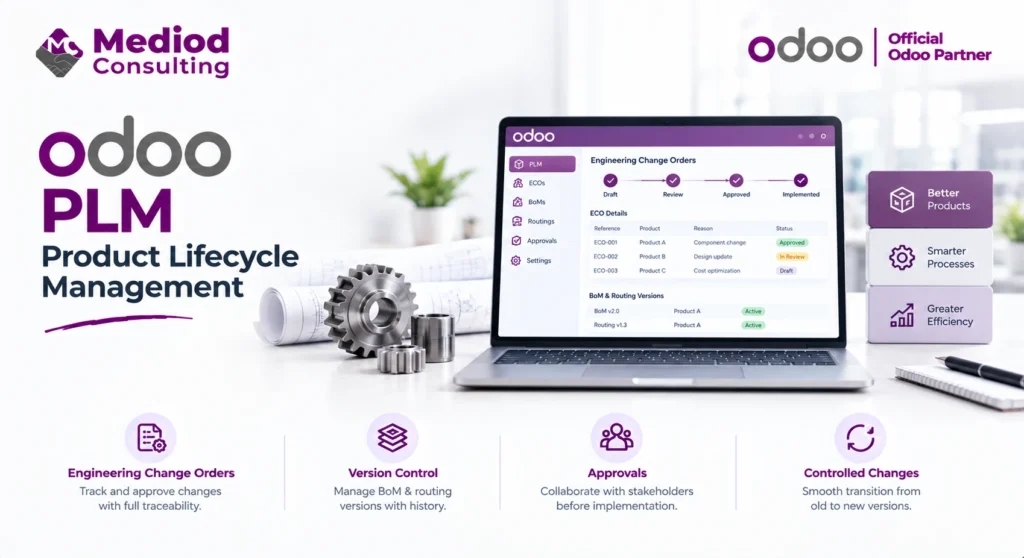
Product Lifecycle Management tracks the evolution of a product’s design and specifications over time — engineering change orders (ECOs), version history on bills of materials and routings, and a controlled process for reviewing and approving changes before they go into effect on the production floor.
Engineering Change Orders
An ECO is a formal, trackable proposal to change something about a product — a component substitution, a dimensional change, a routing adjustment. Rather than editing a live BoM directly and potentially affecting orders already in progress, an ECO lets the change be reviewed, tested, and approved before it becomes the active version, with a clear record of what changed, why, and who approved it.
Version control for BoMs and routings
PLM maintains version history, so you can see exactly what a BoM or routing looked like at any point in time — useful for understanding why an older batch of product was built differently, or for reverting a change that turned out to cause problems.
Managing the transition from old to new versions
When an ECO is approved, PLM helps manage the cutover — determining whether existing manufacturing orders should continue with the old version or switch to the new one, and when the new version becomes the default for future orders. This controlled transition is what prevents the confusion of some orders using outdated specifications without anyone noticing.
When PLM becomes worth implementing
For manufacturers with infrequent, simple product changes, informal BoM updates might be manageable without PLM’s formal process. PLM earns its keep once engineering changes are frequent enough, or the consequences of using an outdated specification are serious enough, that a controlled, auditable change process is worth the additional structure.
Frequently Asked Questions
Does PLM require engineers to use a separate design tool?
No, PLM in Odoo manages the change process and version history within Odoo itself — it’s not a replacement for CAD or design software, but a system for controlling how design changes flow into production.
Can multiple people collaborate on reviewing an ECO?
Yes, ECOs support a review and approval workflow that can involve multiple stakeholders before a change is finalized and put into effect.
How does PLM prevent using an outdated BoM version by mistake?
By maintaining clear version control and a defined cutover process, so the active version at any point is unambiguous rather than relying on someone remembering which BoM edit is the “real” current one.
Control Product Changes With a Formal Process
PLM prevents the confusion and errors that come from informal, untracked product changes. Talk to Mediod Consulting about setting up product lifecycle management for your manufacturing operation.