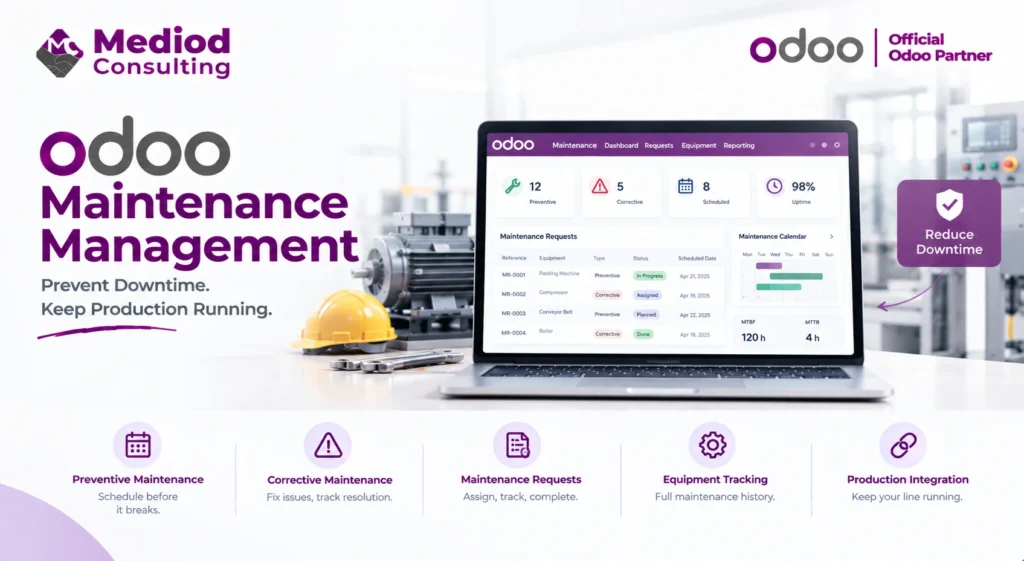
Unplanned equipment downtime is one of the most expensive things that can happen on a production floor — not just the repair cost, but every order that gets delayed while a machine sits broken. Odoo’s Maintenance app aims to catch problems before they turn into unplanned downtime.
Preventive versus corrective maintenance
Corrective maintenance happens after something breaks — reactive by nature, and the most expensive way to maintain equipment because it comes with unplanned downtime attached. Preventive maintenance is scheduled based on time or usage before a failure occurs, and Odoo supports both, letting you configure preventive maintenance schedules for equipment while still tracking corrective work when it’s needed.
Maintenance requests and work orders
When equipment needs attention — whether from a scheduled preventive check or an issue reported by an operator — a maintenance request tracks the work, who it’s assigned to, what was done, and how long it took. This creates a maintenance history for each piece of equipment, useful for spotting patterns like a machine that needs the same repair repeatedly, pointing to a deeper underlying issue.
Connecting maintenance to production planning
Because Maintenance shares data with Manufacturing’s work centers, a machine scheduled for maintenance is visible to production planning — avoiding the situation where a manufacturing order gets scheduled on equipment that’s about to go down for scheduled service. This connection is one of the more practically valuable aspects of running Maintenance inside the same system as Manufacturing rather than as a separate tool.
Predictive maintenance with connected equipment
For equipment with sensor data or usage tracking feeding into Odoo, predictive maintenance can flag likely failures based on actual condition or usage patterns rather than a fixed calendar schedule — more sophisticated than standard preventive maintenance, but requiring the underlying equipment connectivity to support it.
Getting started with maintenance tracking
We generally recommend starting with your highest-value or most failure-prone equipment — setting up preventive schedules and request tracking there first, proving the value, and expanding to the rest of the equipment fleet once the process is established rather than trying to instrument everything at once.
Frequently Asked Questions
Does Odoo Maintenance require IoT sensors or special equipment?
No, standard preventive and corrective maintenance tracking works without any sensor connectivity — sensors are only needed for the more advanced predictive maintenance capability.
Can Maintenance track spare parts inventory needed for repairs?
Yes, maintenance requests can be linked to Inventory, tracking the parts consumed during a repair and their cost against the maintenance record.
How does Maintenance help reduce unplanned downtime specifically?
By catching maintenance needs on a preventive schedule (or predictively, with connected equipment) before a failure occurs, rather than only reacting once a machine has already stopped working.
Reduce Unplanned Downtime With Proactive Maintenance
Preventing downtime is consistently cheaper than reacting to it after production has already stopped. Talk to Mediod Consulting about setting up maintenance management for your equipment.