Most businesses don’t wake up one day and decide they need an ERP — the need builds gradually until specific, recurring pain points make it obvious. Here are the signs we see most consistently in businesses that are genuinely ready.
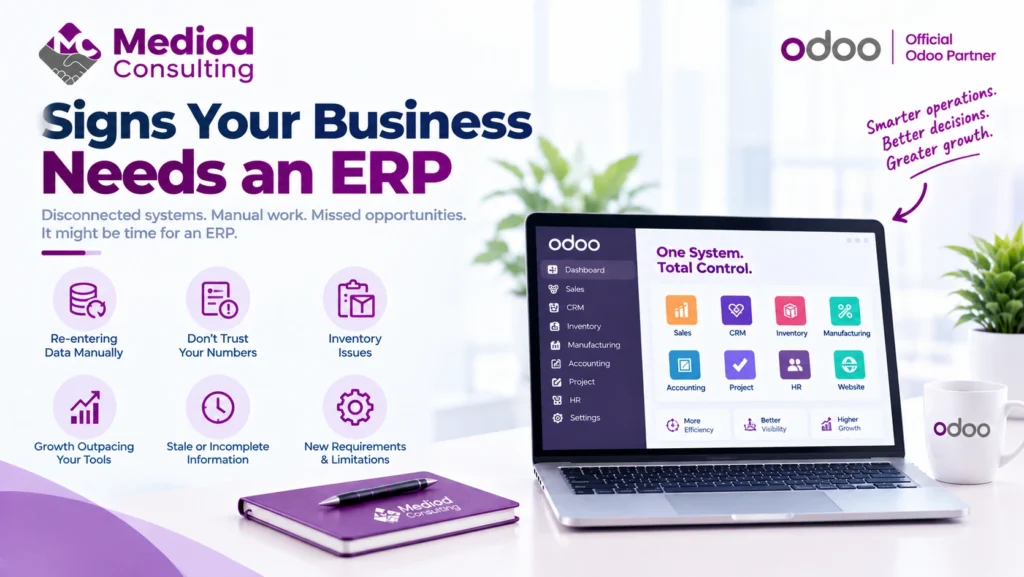
You’re manually re-entering the same data in multiple systems
If someone on your team enters a sale in one system and then manually re-enters it into accounting, or inventory, or a separate CRM, that duplicate effort is both wasted time and a source of inevitable data mismatches between systems. This is one of the clearest, most common signals that disconnected tools have become a real operational cost.
You don’t trust your own numbers
When different departments report different figures for the same thing — sales says one revenue number, accounting shows another — because the data lives in separate systems that don’t reconcile automatically, that’s a sign your reporting infrastructure isn’t keeping pace with your business.
Inventory accuracy is a recurring problem
Frequent stockouts, overselling, or discovering inventory discrepancies only during a physical count points to inventory management that isn’t connected tightly enough to sales and purchasing activity — a core problem ERP systems are specifically built to solve.
Growth is outpacing your current tools
A spreadsheet-based process or simple software tool that worked fine at a smaller scale often breaks down as transaction volume, product complexity, or team size grows — not because the tool got worse, but because it was never designed for the scale you’ve grown into.
You’re making decisions on stale or incomplete information
If getting an accurate picture of the business — current inventory, outstanding receivables, actual project profitability — requires pulling data from multiple sources and manually combining it, decisions are being made slower and with less confidence than they should be.
New requirements your current tools can’t handle
A new sales channel, a new product line requiring manufacturing tracking, multi-location operations, or new compliance requirements can all expose gaps in tools that were adequate for a simpler version of your business.
Frequently Asked Questions
How many of these signs need to be present before ERP is worth considering?
Even one or two consistently recurring signs are usually enough to justify a serious evaluation — these problems tend to compound rather than resolve on their own as a business continues growing.
Is there a business size threshold where ERP starts to make sense?
It’s less about size and more about complexity and connectivity needs — a small business juggling multiple disconnected systems can benefit as much as a larger one with the same underlying problem.
What’s the risk of waiting too long to implement an ERP?
The longer disconnected systems and manual processes persist, the more ingrained they become, and the migration eventually needed tends to get more complex as data volume and process dependencies grow.
Recognize the Signs Before They Become a Bigger Problem
These signs tend to compound the longer they’re left unaddressed. Talk to Mediod Consulting about whether your business is ready for an ERP like Odoo.