Choosing an ERP is a decision most businesses make once every several years, with consequences that last just as long — which is exactly why it’s worth a structured process rather than picking based on a compelling sales demo. Here’s the framework we generally walk clients through.
Start with your actual problems, not a feature list
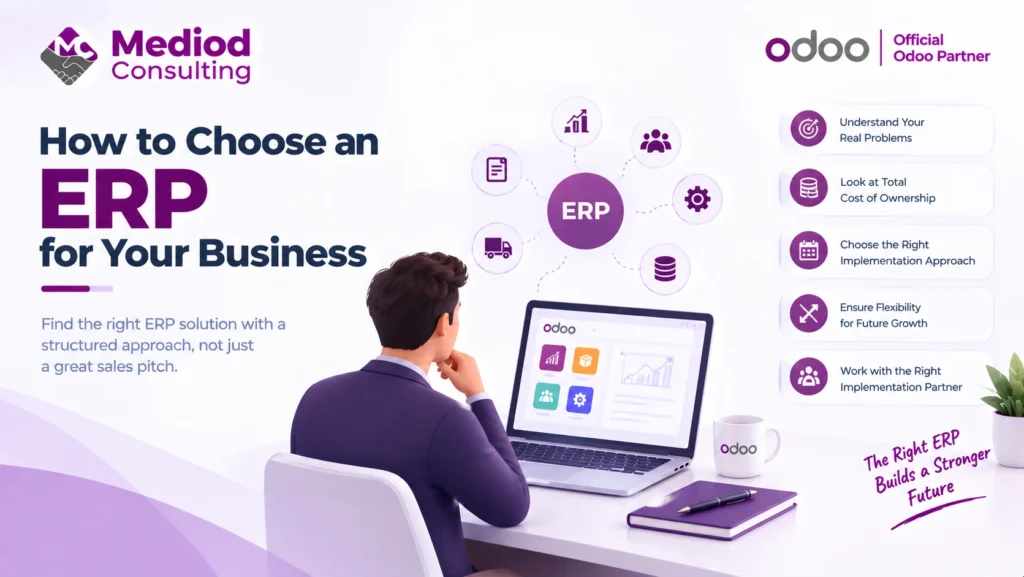
Before evaluating any platform, write down the specific operational problems you’re trying to solve — disconnected inventory and accounting, manual data re-entry between systems, lack of visibility into what’s actually happening across departments. Every platform you evaluate should be assessed against whether it solves these specific problems, not against a generic feature checklist that every ERP vendor will claim to satisfy.
Total cost of ownership, not just license price
Licensing cost is only part of the real cost — implementation, customization, training, and ongoing maintenance all add up, sometimes to a multiple of the license cost itself. Ask every vendor or partner for a realistic total cost picture, including what happens at renewal and what future customization or upgrade costs typically look like, not just the headline pricing.
Implementation approach and timeline
Some ERP platforms favor a big-bang, everything-at-once implementation; others (like Odoo) support a phased, start-narrow-and-expand approach. A phased approach generally carries less risk and shows value faster, which matters if your team needs to build confidence in the new system before going all-in.
Flexibility for how your business actually changes
Businesses evolve — new product lines, new sales channels, acquisitions, new regulatory requirements. Evaluate not just whether a platform fits your business today, but how easily it can adapt as your business changes, since re-platforming a few years after implementation is expensive and disruptive.
Available implementation support
The platform itself matters less than the quality of implementation you actually get — a strong platform poorly implemented delivers worse results than a good-enough platform implemented well. Evaluate potential implementation partners as carefully as the platform itself, including their experience with businesses similar to yours.
Frequently Asked Questions
How long should an ERP evaluation process take?
This varies by business complexity, but rushing this decision tends to be more costly than taking the time to evaluate properly — a few weeks to a couple of months for a structured evaluation is reasonable for most mid-sized businesses.
Should we involve end users in the ERP selection process?
Yes — the people who’ll actually use the system daily often catch practical usability issues that a purely management-level evaluation misses, and their early involvement also builds buy-in for the eventual rollout.
Is it worth doing a pilot or trial before committing to full implementation?
Where possible, yes — a limited pilot on one department or process gives real signal about fit before committing to a full rollout, though not every platform supports this easily.
Choose an ERP Based on Your Actual Needs
A structured evaluation process leads to a better decision than picking based on the most polished sales pitch. Talk to Mediod Consulting about evaluating whether Odoo fits your business’s actual requirements.