SAP, Microsoft Dynamics, and Odoo dominate most ERP shortlists — but they’re built for very different businesses, budgets, and timelines. Picking the wrong one doesn’t just waste money, it can set your operations back years. Here’s how the three actually compare, and where each one makes sense.
Odoo vs SAP vs Microsoft Dynamics at a Glance
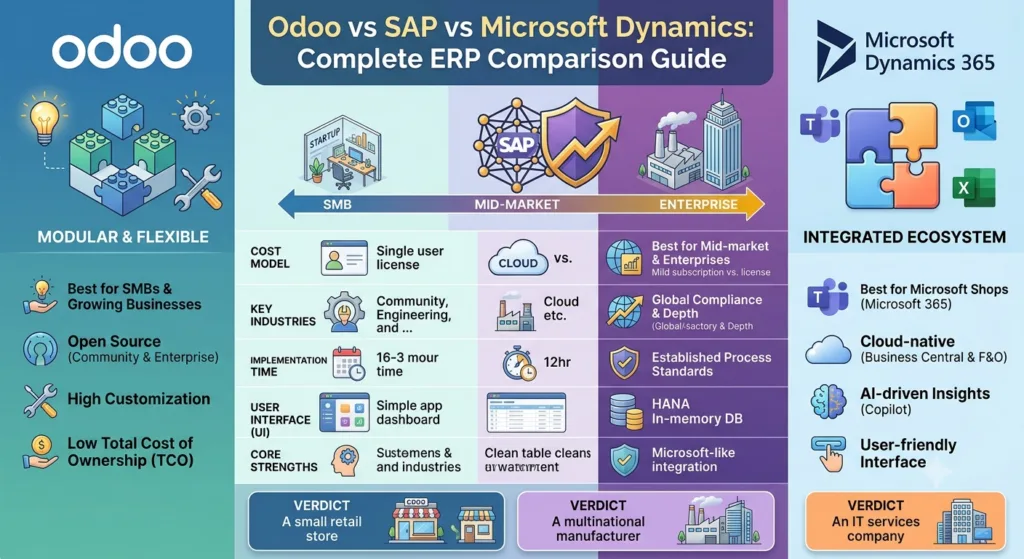
| Odoo | SAP | Microsoft Dynamics 365 | |
|---|---|---|---|
| Licensing model | Open source core + per-app/user subscription | Proprietary, enterprise licensing | Proprietary, per-user subscription |
| Typical business size | SMB to mid-market | Large enterprise | Mid-market to enterprise |
| Implementation timeline | Weeks to a few months | Several months to years | Months |
| Customization | Studio (no-code) + full source access | Extensive but specialist-dependent | Power Platform + custom development |
| Total cost of ownership | Generally lowest | Highest | Mid-to-high |
Cost Differences
This is usually the deciding factor for growing businesses. SAP implementations routinely run into six or seven figures once licensing, infrastructure, and consulting are factored in — a scale that only makes sense for large enterprises. Microsoft Dynamics sits in between. Odoo’s per-app pricing and lower implementation overhead make it the most accessible of the three for small and mid-sized businesses, without giving up breadth of functionality.
Implementation Time & Complexity
SAP implementations are notorious for multi-year rollouts, heavy customization requirements, and specialized (expensive) consulting talent. Dynamics 365 implementations are faster but still substantial. Odoo’s modular architecture means you can go live with core modules in weeks, then add apps as your business grows — instead of one enormous, all-or-nothing rollout.
Customization & Flexibility
Odoo’s biggest structural advantage is that customization doesn’t require a specialized, hard-to-find skill set. Odoo Studio lets non-developers build custom fields, views, and automated workflows directly, and because the codebase is open, deeper customization is always possible without vendor lock-in. SAP and Dynamics both support customization, but typically require certified specialists and longer development cycles.
Which ERP Is Right for Which Business Size
- SAP — large enterprises with complex, multi-country operations and dedicated IT/ERP teams.
- Microsoft Dynamics 365 — mid-market to enterprise businesses already invested in the Microsoft ecosystem.
- Odoo — growing small and mid-sized businesses that want enterprise-grade functionality without enterprise-grade cost or complexity.
Why Businesses Choose Odoo Over SAP and Dynamics
For most companies outside the largest enterprise tier, the calculation comes down to getting real ERP functionality live faster, at a fraction of the cost, without being locked into a single vendor’s roadmap. That’s the gap Odoo was built to fill — and it’s why it’s become the go-to alternative for businesses that outgrew spreadsheets but don’t need (or can’t justify) an SAP-scale deployment.
See Odoo for yourself with a free trial →
Frequently Asked Questions
Is Odoo as powerful as SAP?
For the vast majority of small and mid-sized business use cases, yes — Odoo covers the same core ERP functions (finance, inventory, manufacturing, CRM, HR) at a fraction of the cost and complexity. SAP’s advantage shows up mainly at large-enterprise scale with highly specialized industry requirements.
Can I migrate from SAP or Dynamics to Odoo?
Yes. Data migration from legacy ERP systems is a common project for Odoo implementation partners. See our Odoo migration services for how we handle it.
Which is cheaper long-term: Odoo, SAP, or Dynamics?
Odoo generally has the lowest total cost of ownership for SMBs, thanks to its open-source core, per-app pricing, and shorter implementation timelines. See our detailed cost breakdown.
Does Mediod Consulting help with ERP selection, not just Odoo implementation?
We specialize in Odoo specifically, and can walk you through an honest comparison against SAP and Dynamics for your specific situation — reach out to discuss your requirements.
Get Started with Mediod Consulting
If Odoo looks like the right fit after this comparison, Mediod Consulting can take you from evaluation to a fully live system. Start your Odoo implementation, or contact us for a free consultation — mention this article for a 22% discount on your Odoo subscription.