
Disclosure: This guide contains Mediod Consulting’s official Odoo partner links. Signing up through them costs you nothing extra, and it lets Mediod support you as your local implementation partner from day one.
Odoo is the world’s most-installed open source business software suite — a single platform that replaces the CRM, accounting, inventory, manufacturing, HR, eCommerce, and project tools most companies stitch together from five different vendors. It ships as free, open source Community software you can self-host, and as a hosted Enterprise product with the full app catalog, support, and Odoo Studio. This guide walks through what Odoo actually is, how Community compares to Enterprise, where to download it, what it costs going into 2026, and every major app in the Odoo suite — with direct links to try each one.
Mediod Consulting is a certified Odoo partner. Use the links in this guide to start a free trial, and as our exclusive offer, every reader who signs up through Mediod gets a 22% discount on their Odoo subscription. Just contact us at info@mediodconsulting.com before you subscribe — or even after you’ve already bought your subscription — and we’ll apply the discount.
🎉 Mediod Consulting Exclusive: 22% Off Your Odoo Subscription
Sign up through any link on this page, then email info@mediodconsulting.com (before or after purchase) to claim your discount. As your Odoo partner, we’ll also handle setup, configuration, and support — at no extra cost to browse and compare first.
What Is Odoo? Open Source ERP and CRM Explained
Odoo (formerly OpenERP) is a modular suite of business applications built on a shared database and a consistent interface. Instead of licensing separate, disconnected tools for sales, accounting, inventory, and HR, a company runs all of it inside one system, where a quotation flows straight into an invoice, a sale automatically reserves stock, and a timesheet feeds directly into project costing.
What sets Odoo apart from traditional ERPs like SAP or Microsoft Dynamics is its open source core: the Community edition is free to download, inspect, modify, and self-host under the LGPLv3 license. That openness has built a global developer ecosystem — thousands of community-maintained modules, a large freelance and partner network, and none of the vendor lock-in that comes with proprietary ERP platforms.
Explore Odoo: Open Source ERP and CRM →
Odoo Community vs Enterprise: Is Odoo Still Free to Use?
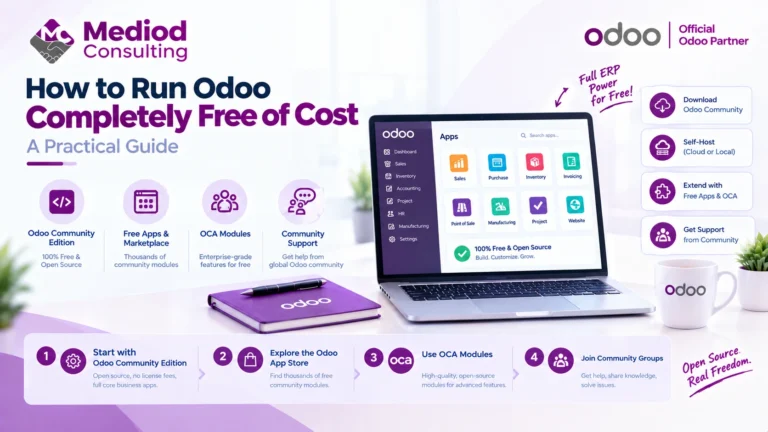
Yes — Odoo Community remains completely free and open source. You can download it, self-host it, and run a full CRM, sales, inventory, or website stack without paying a license fee. Odoo Enterprise is the paid, official edition: it adds the complete app catalog, Odoo Studio, official cloud hosting, mobile apps, and direct support from Odoo S.A.
| Feature | Community | Enterprise |
|---|---|---|
| Cost | Free, open source | Paid subscription (per app or per user) |
| License | LGPLv3 | Proprietary (Odoo S.A.) |
| Hosting | Self-hosted only | Odoo Online, Odoo.sh, or on-premise |
| Odoo Studio | Not included | Included |
| Official support | Community forums only | Direct support + SLA options |
| App catalog | Core apps only | Full suite (Accounting, MRP add-ons, Field Service, etc.) |
Most growing businesses start on Community or a free trial to evaluate fit, then move to Enterprise once they need Studio, official support, or apps that aren’t in the Community build. Mediod helps with both paths — and either way, our 22% partner discount applies to your Enterprise subscription.
How to Download Odoo: Official Site, GitHub & the Odoo Community Association
There are three legitimate places to get Odoo, depending on what you need:
- Official download (odoo.com): the packaged Community edition installers for Windows, Linux, and Docker, plus the option to launch an Enterprise trial instantly in the cloud.
- Odoo open source on GitHub: the full Community source code lives at
github.com/odoo/odoo. This is the canonical repo for anyone who wants to self-host, fork, or contribute custom modules. - Odoo Community Association (OCA): a nonprofit, independent from Odoo S.A., that maintains thousands of free, community-contributed modules that extend Community edition — everything from extra accounting localizations to reporting tools not in the core build.
Self-Hosting Odoo: The Short Version
If you’re comfortable managing a Linux server, a self-hosted Odoo open source tutorial generally follows this shape:
- Provision a server with Python, PostgreSQL, and the required system libraries (or use the official Docker image, which bundles most of this for you).
- Clone the Community source from GitHub, or install via the packaged
.deb/.rpmbuild for your distro. - Configure your PostgreSQL database and the
odoo.conffile (database credentials, addons paths, worker count). - Install any OCA modules your business needs into a custom addons directory.
- Start the Odoo service, create your first database, and install the apps you need from the Apps menu.
Self-hosting gives you full control and zero license fees, but you’re responsible for updates, backups, security, and scaling. Most businesses past a handful of users find it’s cheaper — in time, not just money — to run on Odoo Online or Odoo.sh and let Mediod handle configuration instead. If you’d rather not manage servers yourself, talk to us about a managed Odoo implementation.
Odoo ERP Pricing for 2026
Odoo prices Enterprise by the number of apps and users, not a flat enterprise-wide license fee, which is part of why it’s popular with small and mid-sized businesses. Broadly, the structure looks like this:
- One App Free: run a single Odoo app (like CRM or Invoicing) free indefinitely, for unlimited users, on Odoo Online.
- Standard: access to the full app catalog on a per-user, per-month subscription.
- Custom: the Standard plan plus Odoo Studio, multi-company support, and external API access — for businesses that need deeper customization.
Exact per-user pricing changes periodically and varies by region, so rather than quote a number here that may already be out of date, use the trial link below to see live 2026 pricing, or email us directly for a quote scoped to your team size and apps — remember, mentioning Mediod gets you 22% off whichever plan you choose. We’ve also written a full Odoo Implementation Cost Guide and an Odoo Subscription & Licensing Guidance page covering how licensing costs stack up against implementation and support costs.
Odoo Studio: Build and Customize Apps Without Code
Odoo Studio is Odoo Enterprise’s visual app builder. It lets you add custom fields, redesign forms and views, build automated workflows, design PDF reports, and even create entirely new apps on top of Odoo’s data model — all through a drag-and-drop interface, no development required for most changes.
For businesses with workflows that don’t fit an out-of-the-box module, Studio is often the difference between “close enough” and “exactly how we work.” Mediod also offers hands-on Odoo development services for customizations that go beyond what Studio can do on its own.
Odoo ERP System Features: The Complete App & Module Directory
Every link below is a verified Mediod Consulting partner link. Sign up through any of them and email info@mediodconsulting.com for your 22% subscription discount.
Sales & CRM
Odoo’s CRM tracks leads and opportunities through a visual pipeline, automates follow-ups, and feeds directly into Sales, which turns quotations into orders and invoices without re-entering data.
Accounting & Finance
Odoo Accounting is consistently rated among the best accounting software for growing businesses because it’s built into the same database as sales and inventory — invoices, bank reconciliation, and financial reports stay in sync automatically. Electronic invoicing and expense tracking round out the finance stack.
Inventory, Purchase & Manufacturing (MRP)
Odoo’s warehouse and inventory app handles multi-location stock, barcode scanning, and automated replenishment. Purchase ties supplier orders directly to stock levels, and Odoo’s open-source Manufacturing (MRP) module manages bills of materials, work orders, and work centers for companies that produce rather than just resell — all sharing the same live inventory data instead of syncing between separate systems.
For manufacturing-specific implementation help, see our Odoo development & customization services.
eCommerce & Point of Sale
Odoo’s eCommerce builder ties a public website directly to live inventory, so stock, pricing, and orders never drift out of sync with the backend. Point of Sale extends the same database to physical checkout counters and restaurants.
Human Resources
Odoo HR covers the full employee lifecycle: recruitment, onboarding, appraisals and performance evaluation, time off, timesheets, and workforce planning — each module standalone or combined into a full HR suite.
- Human Resources Software →
- Free Recruitment Software →
- Appraisal & Employee Evaluation →
- Timesheets & Time Tracking →
- Planning Management Software →
Projects & Field Operations
Odoo Project Management organizes tasks, milestones, and timesheets around each client engagement — a natural fit for consultancies and long-running work. Field Service dispatches and tracks on-site jobs, Fleet manages company vehicles, and Helpdesk handles support tickets and SLAs.
- Open Source Project Management →
- Field Service Management →
- Fleet Management Software →
- Helpdesk Software →
Marketing, Communication & Learning
Beyond core operations, Odoo covers outbound marketing (SMS and WhatsApp integration), customer feedback (Surveys), and training (eLearning) — all logged against the same contact and customer records as everything else.
Documents, AI & Rental
Odoo Documents centralizes file storage and approval workflows, Odoo’s AI features are increasingly built into search, drafting, and automation across the suite, and the Rental app manages bookable or leasable assets with automated pricing and return tracking — useful for equipment rental businesses and for any long-term, subscription-style rental arrangement.
Odoo for Long-Term Projects, Subscriptions & Rentals
A recurring question from growing teams (including threads like “Long term subscription” discussions on r/Odoo) is whether Odoo holds up for engagements that run for months or years rather than one-off transactions. It does — and it’s actually one of Odoo’s stronger use cases:
- Long-term project management: Project + Timesheets tracks budgets, milestones, and billable hours across engagements that span many months, with real-time cost-vs-budget visibility instead of a spreadsheet reconciled after the fact.
- Recurring/subscription billing: Odoo can automate recurring invoices for retainer clients or subscription products, so long-term contracts don’t rely on someone remembering to invoice manually each month.
- Long-term rentals: the Rental app handles extended leasing periods, automatic price tiers for longer terms, and return/renewal tracking — not just short-term equipment hire.
Because Odoo licensing is also priced as an ongoing subscription, locking in a longer-term plan through a partner is where the 22% Mediod discount compounds the most value — it applies for the life of your subscription, not just the first invoice.
Best Odoo Alternatives: Open Source & Self-Hosted
Odoo isn’t the only open source ERP, and it’s worth knowing the landscape:
- ERPNext — a fully open source ERP with a smaller app catalog than Odoo but a simpler, more opinionated setup.
- Dolibarr — lightweight and free, popular with very small businesses that need basic CRM/invoicing without a large app suite.
- Tryton — a modular, developer-focused ERP framework with a smaller community than Odoo’s.
What keeps most businesses on Odoo after comparing alternatives is breadth: one connected suite covering sales, accounting, inventory, HR, and manufacturing, backed by the largest open source ERP community and partner network in the space — including certified implementation partners like Mediod, who can configure it for your specific industry rather than leaving you to figure it out alone.
Try Odoo Free: Online Trial & Free Demo Database
You don’t need to commit to anything to see whether Odoo fits your business. Use our trial link above to launch a live Odoo Online demo database preloaded with sample data — free for 30 days, no credit card required.
As a Mediod Consulting client, you can also reference our partner subscription code M23052984318833 when setting up your database, or simply mention it to us at info@mediodconsulting.com. It links your trial to Mediod as your implementation partner, and because we manage that relationship directly with Odoo, we can request an extension on your free trial period if you need more time to properly evaluate it before committing.
Frequently Asked Questions
Is Odoo still free to use?
Yes. Odoo Community edition is free, open source, and self-hostable under the LGPLv3 license. Odoo Enterprise, which adds the full app catalog, Odoo Studio, and official support, is a paid subscription.
What’s the difference between Odoo Community and Enterprise?
Community is free, self-hosted, and limited to core apps. Enterprise is a paid subscription (self-hosted, Odoo.sh, or Odoo Online) that adds the complete app suite, Odoo Studio, mobile apps, and direct support from Odoo.
Where can I download Odoo open source?
Directly from odoo.com for packaged installers, from github.com/odoo/odoo for the source code, or through the Odoo Community Association (OCA) for additional free, community-maintained modules.
Can I self-host Odoo?
Yes, Community edition is designed to be self-hosted on your own server or via Docker. You’ll be responsible for updates, backups, and security, or you can have Mediod manage a self-hosted deployment for you.
Does Mediod Consulting offer an Odoo discount?
Yes — sign up through any link in this guide and email info@mediodconsulting.com, before or after you subscribe, and we’ll apply a 22% discount to your Odoo subscription.
How do I get a free Odoo demo database?
Use our trial link above, or reference partner subscription code M23052984318833 with your database request. It’s free for 30 days, and Mediod can request an extension on your behalf if you need more evaluation time.
Get Your Odoo Implementation Started with Mediod Consulting
Whether you’re comparing Odoo to other ERPs, deciding between Community and Enterprise, or ready to migrate off your current system, Mediod Consulting is a certified Odoo partner offering end-to-end Odoo implementation, migration, integration, ongoing support, and training. Sign up through any link on this page and email info@mediodconsulting.com for your 22% subscription discount — before or after you buy.