
“How long will this take?” comes up in almost every scoping call, usually right after the cost question. The honest range we give is broad — anywhere from six weeks for a focused, single-department rollout to six months or more for a multi-entity, multi-application implementation — because the timeline follows the same scope factors that drive cost.
The phases that make up an implementation timeline
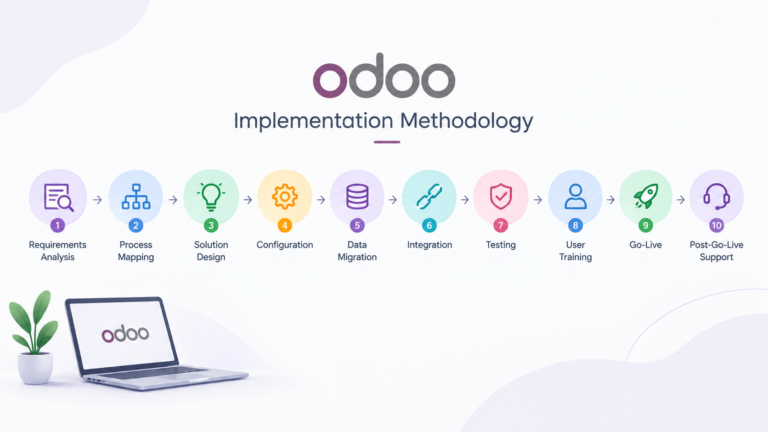
Regardless of project size, an Odoo implementation moves through the same sequence. What changes with scope is how much time each phase needs, not whether it happens.
- Business requirements analysis. Understanding current processes, pain points, and what the business actually needs the system to do. Rushing this phase is the single most common cause of timeline slippage later — a requirement missed here surfaces as rework during configuration or, worse, after go-live.
- Business process mapping and solution design. Translating requirements into a concrete plan: which Odoo applications, what configuration, what customization (if any), what integrations.
- Configuration. Setting up Odoo according to the approved design — this is usually the phase people picture when they think of “implementation,” but it’s rarely the longest one.
- Data migration. Extracting, cleaning, mapping, and validating data from existing systems. Timeline here depends heavily on data quality going in, not just data volume.
- Integration. Connecting Odoo to ecommerce platforms, payment providers, or other business systems, where applicable.
- Testing. Running real business scenarios through the configured system before anyone’s daily work depends on it.
- User training. Getting the team comfortable with the applications and workflows relevant to their role.
- Go-live and post-go-live support. The cutover itself, followed by a stabilization period where issues that only show up under real usage get resolved quickly.
Rough timelines by project size
These are starting points, not guarantees — every project’s actual timeline comes out of its own requirements analysis, not a generic table. But as a general sense of scale:
- Focused, single-department implementation (e.g., Sales, Inventory, and Accounting for a small business with reasonably clean data): often 6-10 weeks.
- Standard multi-application implementation (adding Purchase, Manufacturing, or Ecommerce, moderate data migration, one or two integrations): typically 3-5 months.
- Complex, multi-entity, or heavily customized implementation (multiple companies or locations, significant legacy data, several integrations, real customization work): 6 months or longer.
What actually extends a timeline
In our experience, the same handful of things push timelines out, and none of them are really about Odoo itself:
Incomplete or inconsistent source data. A migration plan built assuming clean data falls apart when the actual export turns out to have duplicate customer records, missing product codes, or years of inconsistent categorization. This isn’t a reason to skip validation — it’s the reason validation exists.
Scope changes mid-project. Adding an application or a new integration requirement after configuration has started is sometimes necessary, but it resets part of the plan rather than just adding to the end of it.
Slow decision cycles on the client side. Configuration and testing phases need timely feedback and sign-off. A project with a single, empowered decision-maker moves faster than one requiring committee approval at every stage.
Underestimated training needs. A team new to any ERP, not just Odoo, needs more runway to get comfortable before go-live than a team that’s used similar systems before.
Frequently asked questions
Can Odoo be implemented faster than SAP or NetSuite?
For comparable scope, generally yes — Odoo’s modular, configuration-first approach tends to move faster than legacy enterprise ERP implementations, though the real timeline always depends on the specific requirements.
Does a phased rollout take longer overall?
It can extend the total calendar time, but it reduces risk and lets the business start realizing value from the first phase while later phases are still being planned — often the better trade-off for growing businesses.
What’s the fastest realistic Odoo implementation?
A narrow, single-application rollout with clean existing data and a small user base can go live in as little as 4-6 weeks, though this is the exception rather than the norm.
For a realistic timeline specific to your business, our Odoo Implementation Services page outlines our process, or reach out and we’ll scope it directly.