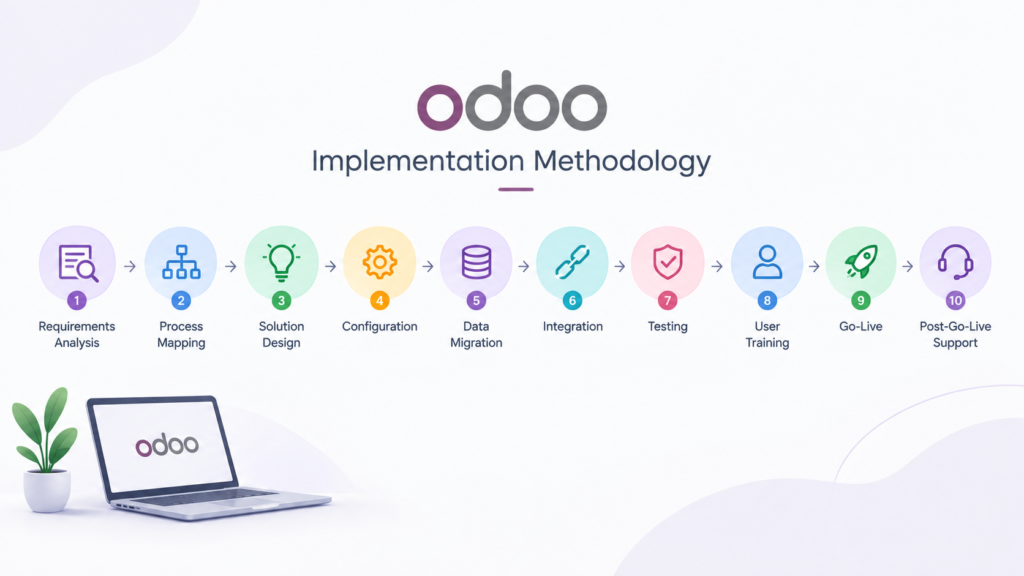
Odoo itself doesn’t enforce an implementation methodology — you could, in theory, just start clicking through settings and see what happens. We don’t recommend that approach, and neither does Odoo’s own official documentation, which is why most experienced partners converge on a similar structured sequence even without a shared formal framework.
Why methodology matters more than tooling
The applications, the configuration screens, the data import tools — none of that is where implementations actually go wrong. What goes wrong is sequence: configuring before requirements are understood, migrating data before it’s validated, training users on a system that’s still being changed underneath them. A methodology is really just a discipline about order of operations.
The sequence we follow
1. Business requirements analysis
Understanding what the business actually needs before touching Odoo at all — current processes, pain points, compliance requirements, and what “success” looks like for this specific implementation. Skipping this to save time almost always costs more time later, when a missed requirement surfaces mid-configuration.
2. Business process mapping
Documenting how work currently flows end to end, including the informal workarounds that don’t appear in any process document but that people actually rely on day to day.
3. Solution design
Translating the mapped processes into a concrete Odoo configuration plan: which applications, what configuration, what — if any — customization, and what integrations are needed. This is the point where the project gets a real shape, and where the client should be reviewing and signing off, not seeing it for the first time once it’s built.
4. Configuration
Building the approved design in Odoo. We lean on standard configuration wherever it genuinely covers the requirement, reserving customization for cases where it doesn’t.
5. Data migration
Extracting, cleaning, mapping, and migrating data from existing systems, with a test migration into staging before anything touches the production database.
6. Integration
Connecting Odoo to ecommerce platforms, payment providers, or other systems the business is keeping.
7. Testing
Running actual business scenarios through the configured system — not a feature-by-feature checklist, but the real workflows people will use daily.
8. User training
Training scoped to what each role actually needs to do in the system, not a generic walkthrough of every application.
9. Go-live
The cutover itself, ideally scheduled for a low-activity period with the team available to respond quickly if something unexpected comes up.
10. Post-go-live support
A stabilization period where issues that only appear under real usage get resolved quickly, followed by ongoing support as the business settles into the system.
Where methodologies diverge: phased vs. big-bang
The sequence above holds regardless of approach, but there’s a real decision about whether to roll out all applications at once (“big-bang”) or in stages (“phased”). Big-bang gets the whole business onto Odoo simultaneously but concentrates risk into a single go-live event. Phased rollout — often starting with Sales, Inventory, and Accounting, then adding Manufacturing or Ecommerce later — spreads risk and lets the business start realizing value earlier, at the cost of running two systems in parallel for longer. We usually recommend phased for businesses with more than a handful of departments or any real process complexity, and big-bang for smaller, simpler implementations where the coordination overhead of a phased approach isn’t worth it.
Frequently asked questions
Does Odoo have an official implementation methodology?
Odoo’s own documentation recommends a structured approach — test database, configuration, thorough testing, then production deployment — but doesn’t mandate a single named framework the way some enterprise ERPs do.
Is Agile implementation possible with Odoo?
Yes, particularly for phased rollouts — treating each application or department as its own iteration works well with Odoo’s modular structure.
How much of the methodology can be skipped for a small business?
The sequence stays the same regardless of size; what changes is how much time each phase needs. A small, simple implementation moves through the same ten steps, just faster.
To see how this methodology applies to your specific business, visit our Odoo Implementation Services page or get in touch.