Startups face a specific version of the “which software” problem — limited budget, fast-changing requirements, and no time to waste on a system that won’t scale. Odoo gets evaluated by a lot of startups for exactly these constraints, not despite them.
Why Odoo comes up in startup conversations
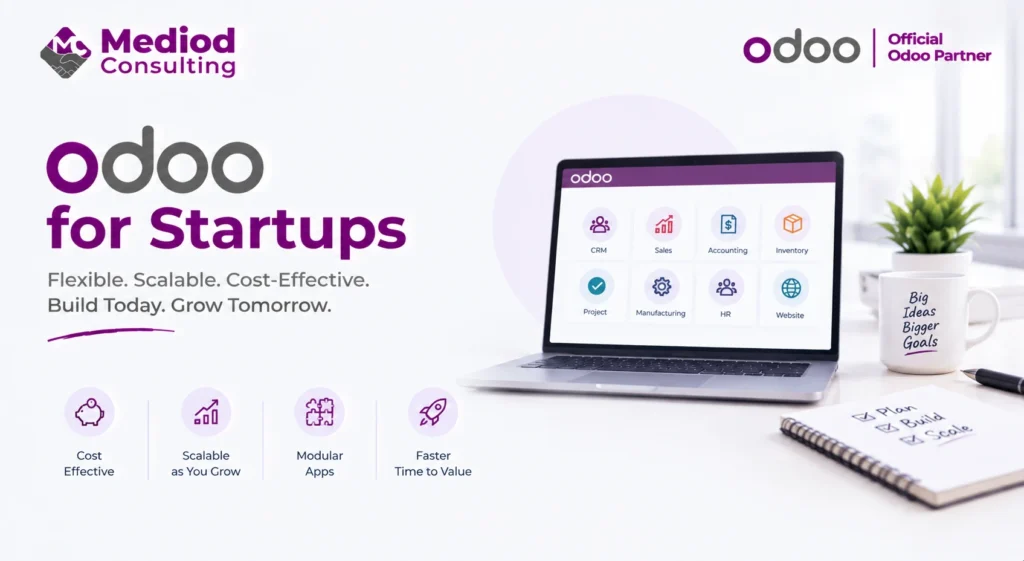
Community edition’s free licensing removes the upfront cost barrier that makes sense for a startup watching runway closely, and the modular structure means you’re not paying for enterprise functionality you won’t use for years, if ever. The bigger reason it keeps coming up, though, is that startups’ requirements change fast — Odoo’s breadth means you can add Manufacturing, Ecommerce, or HR later without switching platforms as the business evolves.
What a startup should actually implement first
We generally recommend starting narrow — Sales and CRM if you’re building a sales pipeline, Accounting and Invoicing if getting paid reliably is the immediate priority, or Inventory if you’re already shipping product. Trying to configure a full ERP stack before you’ve validated the business is a common way startups waste early-stage time and money on software rather than the product itself.
Scaling with the business, not against it
The advantage that matters most for a startup isn’t any single feature — it’s not having to re-platform later. A startup that starts with Odoo for basic Sales and Accounting can add Inventory when it starts holding stock, Manufacturing if it starts producing, or HR as headcount grows, all inside the same system rather than migrating to a bigger platform once outgrowing a startup-specific tool.
Where a lighter tool might still make sense
If your startup’s entire near-term need is genuinely one narrow function — just invoicing, say, with no plans to expand into broader operations soon — a simpler, more specialized tool might get you moving faster with less setup. The tradeoff is worth considering honestly rather than assuming Odoo’s breadth is always the right starting point.
Frequently Asked Questions
Is Odoo too complex for an early-stage startup?
Not if you start narrow — implementing just the 1-2 apps you actually need avoids the complexity that comes from trying to configure everything at once.
How much does an Odoo implementation typically cost for a startup?
Community edition licensing is free; cost is concentrated in implementation time. A narrow, focused first implementation is significantly cheaper than a full ERP rollout. See our Odoo Pricing guide for a full breakdown.
Can a startup outgrow Odoo?
Odoo scales into genuinely large operations, so outgrowing it entirely is uncommon — the more common scenario is a startup gradually adding more Odoo functionality as it grows, rather than needing to leave the platform.
Build a Foundation That Grows With You
The right starting scope for a startup is narrow and focused, not a full ERP rollout on day one. Talk to Mediod Consulting about scoping the right first implementation for your startup.