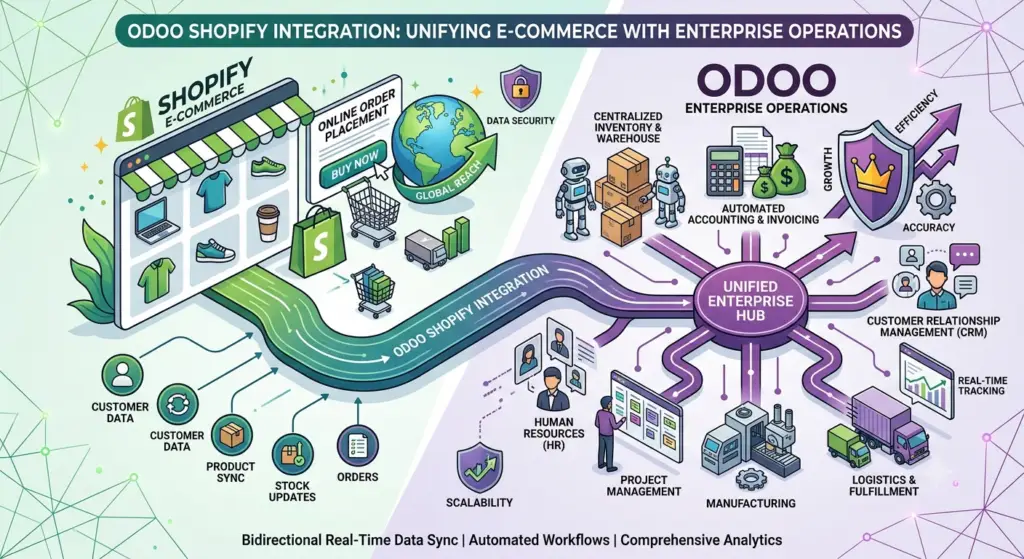
In modern digital retail, managing a fast-growing online storefront alongside backend operations presents significant operational challenges. While Shopify provides an exceptional front-end shopping experience, managing inventory, orders, customer details, and accounting across disconnected platforms creates operational bottlenecks, stock discrepancies, and fulfillment delays.
Connecting Shopify with Odoo ERP transforms isolated sales channels into a single, automated operational ecosystem. As a specialized technical and functional service provider, Mediod Consulting helps businesses bridge front-end digital stores with robust back-office ERP workflows through seamless Odoo Shopify integration.
Why Connect Shopify with Odoo ERP?
Shopify excels at converting website visitors into buyers, while Odoo provides complete enterprise resource planning—spanning inventory control, procurement, double-entry accounting, customer relationship management (CRM), and multi-warehouse routing. Without integration, staff must manually copy order details, update inventory levels, and recreate invoices across platforms.
Integrating Odoo with Shopify creates a unified commerce ecosystem where data flows bidirectionally in real time or on scheduled triggers. Orders placed on Shopify automatically appear inside Odoo to initiate pick, pack, and ship workflows. Simultaneously, stock level changes in Odoo immediately update on Shopify, establishing single-source operational control.
Key Capabilities of Odoo Shopify Integration
Want to see these capabilities running on your own store before committing? Start a free Odoo eCommerce trial — sign up through that link and email info@mediodconsulting.com for a 22% discount on your subscription, before or after you buy.
1. Real-Time Product & Variant Synchronization
Managing complex product catalogs with multiple SKUs, color options, sizes, pricing rules, and metafields across platforms is prone to manual errors. With Odoo Shopify integration, product details created or modified in Odoo automatically sync to Shopify.
- Bidirectional syncing for product titles, descriptions, categories, and images.
- Multi-variant handling mapped accurately across SKUs.
- Centralized pricing and promotional updates pushed directly to the online store.
2. Multi-Warehouse Inventory Governance
Overselling and stockouts damage customer trust and erode retail revenue. Odoo’s advanced inventory module tracks stock across multiple warehouses, retail locations, and fulfillment centers.
- Live stock synchronization updates available inventory counts on Shopify instantly.
- Automated reordering rules in Odoo trigger vendor purchase orders before stock hits critical levels.
- Support for multi-store setups, assigning specific inventory rules and locations per storefront.
3. Automated Order Processing & Shipping Tracking
Manual order processing slows fulfillment cycles and increases delivery errors. When a customer completes a purchase on Shopify, order details—including line items, taxes, shipping preferences, and applied discounts—import directly into Odoo.
- Automatic creation of sales orders and delivery orders inside Odoo.
- Generation of shipping labels through carrier integrations (e.g., DHL, FedEx, UPS).
- Automated transmission of tracking numbers back to Shopify to update the customer in real time.
4. Seamless Financial Accounting & Tax Alignment
Reconciling online store payouts against ledger entries is often time-consuming for accounting teams. Integration automates financial transaction records:
- Direct conversion of sales orders into draft or finalized customer invoices inside Odoo.
- Automated tax rule alignment to maintain localized regulatory compliance.
- Instant synchronization of payment gateway settlements (e.g., Stripe, PayPal) for automated bank reconciliation.
Technical Integration Approaches: Connector vs. Custom API Bridge
Depending on business scale and technical complexity, integration can be executed through two main implementation models:
- Standard Connector Modules: Ideal for standard retail setups with modest transaction volumes and standard product structures. These connectors leverage Odoo and Shopify APIs to automate core order, product, and stock updates efficiently.
- Custom API Bridges & Tailored Workflows: Designed for complex enterprise requirements, such as multi-company structures, specialized B2B pricing tiers, custom product configurators, or high order volumes. Custom RESTful or XML-RPC API connections built by development specialists ensure error logging, custom data field mapping, and stable high-volume data execution.
Strategic Advantages of Choosing Mediod Consulting
Executing a reliable integration requires both technical development skills and deep functional knowledge of ERP workflows. Mediod Consulting provides end-to-end integration services engineered for security, accuracy, and long-term scalability.
- Techno-Functional Expertise: As an official Odoo partner, Mediod Consulting combines deep Python framework knowledge with functional consultancy.
- Tailored Mapping & Data Cleansing: We analyze product catalogs, variant attributes, and accounting structures to ensure error-free data alignment before go-live.
- Robust Security & Exception Logging: Built-in error handling and active monitoring prevent silent data synchronization failures.
- Post-Deployment Support: Continuous optimization, updates, and maintenance to ensure integration remains compatible across new Odoo and Shopify releases.
Frequently Asked Questions
How long does an Odoo Shopify integration take to set up?
A standard connector-based integration typically takes one to three weeks, depending on catalog size and how many workflows (orders, inventory, accounting) you want automated. A custom API bridge for complex multi-company or high-volume setups takes longer — talk to our team for a realistic timeline based on your store.
Do I need Odoo Enterprise to integrate with Shopify?
Odoo’s eCommerce and Inventory apps are available on both Community and Enterprise, though Enterprise adds Odoo Studio for easier custom field mapping and official support. Mediod Consulting can recommend the right plan for your specific integration scope.
Can Odoo handle both Shopify and marketplace sales in one place?
Yes — Odoo’s Inventory and Sales apps are built to manage stock and orders across multiple sales channels from a single backend, so Shopify, marketplaces, and any physical Point of Sale locations all stay in sync.
Get Started with Mediod Consulting
Disconnects between your storefront and backend systems slow down delivery, increase operational expenses, and limit scaling capacity. Unifying Shopify with Odoo ERP gives your organization single-source control over stock, order processing, and financial accounting.
Partner with Mediod Consulting to build a secure, automated, and scalable Odoo Shopify integration tailored to your growth objectives. Talk to our integration team to schedule a technical discovery session, or start a free Odoo eCommerce trial today — mention Mediod for your 22% partner discount.