
Odoo is a suite of business management software tools including CRM, eCommerce, Billing, Accounting, Manufacturing, Warehouse, Project Management, and Inventory Management.
Odoo was founded by Fabien Pinckaers in February 2005. Since then, it’s grown into a suite of 70+ integrated business apps.
Its most recent stable release at the time of writing is Odoo 16.0, released October 2022.
Odoo is written primarily in Python, with JavaScript powering its front-end.
The software was first named TinyERP, and three years later its name changed to OpenERP. It received industry recognition under that name, including the Trends Gazelle award, the Deloitte Technology Fast 50 award, and InfoWorld’s BOSSIE Award in 2013. After changing its name to Odoo, it went on to win consecutive BOSSIE Awards in 2014, 2015, and 2016.
An Introduction to Odoo 16
Odoo 16 is the latest release — Odoo puts out a new version every year. Odoo 16 shipped with real advancements in application performance, user interface, and operational speed, reflecting where modern ERP is headed.
Odoo 16 brings deeper business intelligence, a state-of-the-art reporting feature for MRP and stock, and a complete front-end website builder. Overall performance improved significantly compared to the previous version.
Performance
Odoo 16 marked a real improvement in ERP performance. Operations run roughly twice as fast as the previous version. Page loading and rendering is 3.7 times faster, and eCommerce pages load 3.9 times faster.
- Odoo 16 runs on PostgreSQL 12, which supports parallel query execution and improved query optimization.
- Server architecture improvements let it process more requests per second.
- Data handling improved, allowing faster reads and writes.
- Image handling was upgraded, so images load and save faster too.
- A new caching mechanism speeds up data loading.
- The API was improved to process more requests, faster.
Curious how Odoo’s current version compares, or which edition fits your business today? See our full Odoo ERP guide for up-to-date features, pricing, and modules, or contact Mediod Consulting for a live walkthrough.
What Are the New General Features of Odoo 16?
Odoo 16 shipped with a wide range of new features aimed at making business operations more efficient and productive. Here’s a look at what’s worth knowing.

Odoo 16 Introduces a New Module
Knowledge Module
The new module Odoo introduced in version 16 is Knowledge — a tool for storing, sharing, and organizing information across the organization. It lets users create and manage documents and knowledge bases, with uploads directly from a computer or an Excel sheet. Teams can collaborate on documents and share them with others, making it a genuine info-sharing hub for business processes, informative articles, administrative guidelines, and more. It also helps keep track of communication happening inside the company.
Using this module, you can centralize organizational information, access it easily, and boost productivity by strengthening how the workforce interacts with company knowledge.
The New Search Bar
On the Odoo 16 dashboard, you’ll find a redesigned search bar for faster searching.
New Menu Under the Favorites Tab
Clicking the Favorites tab now shows two new menu options: “Insert View in the Article” and “Insert Link in the Article.”
Help Icon
A help icon (a question mark) now appears at the top corner of each field in form view. It’s only visible when developer mode is active.
Internal Link
Odoo 16 adds an internal link option on many-to-one fields, useful for jumping straight to a record’s form view.
Rearranged Button Layout — No More Edit Button
Odoo 16 reworks the button layout — the separate Edit button is gone. The Create button has moved from the top-left to the top-right corner, alongside the print and action buttons.
There’s no separate edit-and-save step anymore: clicking any field puts it into edit mode directly, and entries save automatically without a manual save step.
Two icons remain available for manual control: “Save manually” and “Discard changes.”
Sign Module
The Sign module also gets updates in Odoo 16. Recipients can now decline to sign a document. An auto-signature is proposed by default if a user hasn’t provided one. Signing now works well on mobile devices too, and a visual frame is added to signatures so signed copies carry a clear visual indicator that they were signed electronically.
eCommerce and Website
Odoo’s eCommerce and Website modules keep expanding, and Odoo 16 brings several improvements: bulk image uploads for multiple products (in grid or carousel view), simpler back-in-stock notifications for customers, one-click access to back-end views for products, events, and appointments, and the ability to adapt image appearance for mobile, tablet, and desktop.
Main Improvements in Odoo 16
- Improved database performance
- A new Odoo GraphQL API
- Faster web client performance
- Improved reporting
- Faster form rendering
- A refreshed interface
- Improved security
- Better search performance
- Faster module loading
- Faster search overall
These are just a few of the new features in Odoo 16 — a strong platform for business, combining powerful functionality with a genuinely user-friendly interface.
Why Choose Odoo ERP?
Odoo is one of the most widely used ERP platforms on the market. It’s not just a single piece of software — developers can pull apps from the Odoo App Store to fit their needs, and choose themes to customize the UI.
Reasons to Choose Odoo
- Open source
- Odoo apps and modules
- Worldwide support
- Third-party integration
- Flexibility
Let’s look at each of these in more detail.
Open Source: Odoo’s open-source platform is what makes it approachable for developers to build on.
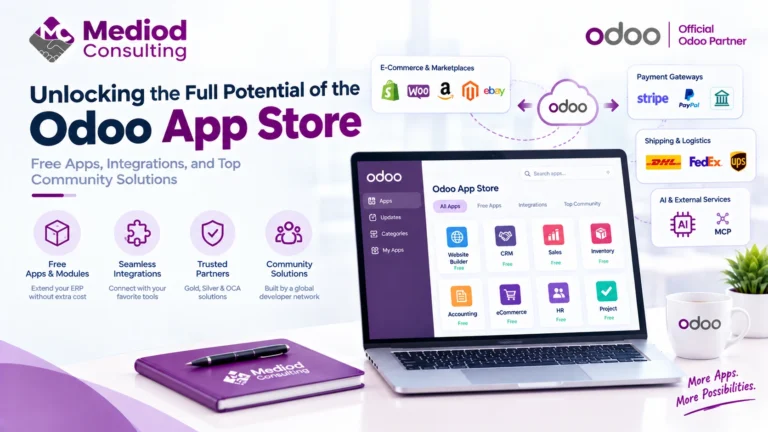
Odoo Apps and Modules: A major part of Odoo’s appeal is its app store — a collection of over 15,000 apps. Both Odoo partners and independent developers can publish apps there, free or paid.
Worldwide Support: Odoo customers benefit from a genuinely global support network, with apps and modules built by developers around the world.
Third-Party Integration: One of Odoo’s biggest advantages over other ERP platforms is how well it integrates with third-party systems.
Flexibility: Odoo is known for its adaptability. Being highly modular, businesses can choose exactly the modules they need, and customize them further as requirements change over time.
Frequently Asked Questions
Is Odoo still under active development?
Yes. Odoo ships a major new version every year, each adding features, performance improvements, and new apps. Odoo 16 covered in this post was one release in that ongoing cycle.
Do I need to upgrade to the latest Odoo version?
Not immediately, but staying several versions behind makes an eventual upgrade larger and more complex. Our migration team can assess your current version and plan a safe upgrade path.
Is Odoo free to use?
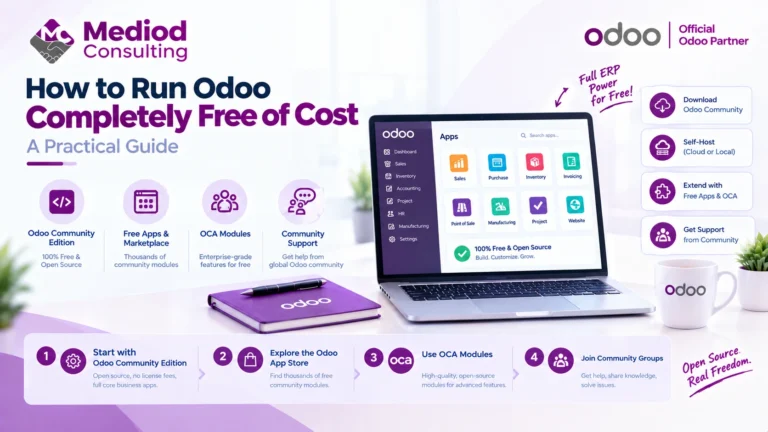
Odoo Community edition is free and open source. Odoo Enterprise, which includes the full app catalog, Odoo Studio, and official support, is a paid subscription.
Get Started with Mediod Consulting
Whether you’re evaluating Odoo for the first time or planning an upgrade from an older version, Mediod Consulting is a certified Odoo Partner ready to help. Book a free consultation, or explore our implementation and migration services.
Want to try Odoo yourself? Start a free Odoo trial — sign up through that link and email info@mediodconsulting.com for a 22% discount on your subscription, before or after you buy.